As I said below, we've been busy. Here's some examples of what we've been doing. Just click the link and you can get to a blog for Kiva Fellows.
http://fellowsblog.kiva.org/2007/11/16/do-what-you-know/
You can see a compendium of my journal entries for Kiva/Maxima if you click on the link over to the right of this page called "Kiva Fellows Posts"
Friday, November 16, 2007


What Have We Been Up To?
Man . . . it's been a busy last few weeks. Since early October we've been working as Fellows with a microfinance institutution (MFI) here in Phnom Penh. Micro-finance has been around in various forms for over a hundred years but most people date its crossover into wider familiarity with the Grameen Bank in Bangladesh in the 1970's. The founder, a man named Muhammad Yunus, was awarded the Nobel Peace Prize for his efforts. (It's a fascinating story if you click on those links.)
As I understand it, the idea of microfinance is to loan money to people who otherwise have no access to credit either:
1) ... in sums large enough to do anything more than pay for day-to-day living expenses or...
2) ... at interest rates low enough to allow them to pay it back without incurring further debt.
Perhaps the most common question asked and certainly the first one I asked was, "If the lendees can pay back the loans with interest, why don't they just save the money themselves and save the interest cost?" I've been told by several loan recipients that the schedule of making loan payments enforces a discipline that they would otherwise find elusive. These people do not put money in the bank. They are too poor (most earn around US $2.00 a day, give or take) , bank branches are few and far between and Cambodia has a recent history of bank failure and total loss of funds due to civil war and corrupt mismanagement. So, the money of the people our MFI works with stays in their homes. And when the money is there, they tell is there is always some need that causes them to spend it - whether it's a child that needs clothes or an extended family member that has an emergency. The fact that a loan officer visits them once a month gives them the excuse to say, "No, I can't spend it."
As I understand it, the idea of microfinance is to loan money to people who otherwise have no access to credit either:
1) ... in sums large enough to do anything more than pay for day-to-day living expenses or...
2) ... at interest rates low enough to allow them to pay it back without incurring further debt.
Perhaps the most common question asked and certainly the first one I asked was, "If the lendees can pay back the loans with interest, why don't they just save the money themselves and save the interest cost?" I've been told by several loan recipients that the schedule of making loan payments enforces a discipline that they would otherwise find elusive. These people do not put money in the bank. They are too poor (most earn around US $2.00 a day, give or take) , bank branches are few and far between and Cambodia has a recent history of bank failure and total loss of funds due to civil war and corrupt mismanagement. So, the money of the people our MFI works with stays in their homes. And when the money is there, they tell is there is always some need that causes them to spend it - whether it's a child that needs clothes or an extended family member that has an emergency. The fact that a loan officer visits them once a month gives them the excuse to say, "No, I can't spend it."
 Loan officer disburses a loan (US Dollars are the default currency in Cambodia)
When they do get the loan, they suddenly have open to them choices they never had before. For example, we interview many people who make their livings by weaving cloth on hand and foot operated looms. For generations many of these people had only one avenue of managing their cost and income. They would get thread from local middlemen who also serve as the sole buyers of finished cloth. The typical arrangement our clients describe is a middleman extending 0a weaver credit of enough thread to make three finished pieces of cloth with the middleman taking two and the weaver taking the profit (with a price set by the middleman!) for the third. Apparently they got by but there was little or no movement up any economic ladder. Now, a weaver can get a loan for a few hundred dollars, travel the ten to thirty kilometers into Phnom Penh to one of the large markets and buy the supplies themselves for a lower cost. When they have completed enough finished pieces, they can take them into the city and sell them for a higher cost. The power of capital! Weaver on the Mekong island of Koh Dach
Other business fare better, as well. Many farmers formerly could only afford a limited amount of seed, fertilizer, pesticide, etc. because they had a long period of waiting before they harvested and sold the produce. Now, they can take out a loan at a reasonable interest rate, buy larger amounts of materials and harvest and sell more at the end of a growing cycle. Many MFI's even offer a special loan product for farmers that allow them to make small payments early in the cycle when they have no cash flow saving the larger payments for the end of the growing/harvesting cycle. Whatever the situation, my experience in five weeks of interviewing clients is that they are very happy to have access to the funds.
So what's the role of Tami and I in all this? We applied to work with this organization from San Francisco called KIVA. They worked out a system set up on the Web to connect individual lenders (NOT donors) with people in need in the developing world. If you go to their website they explain it in detail. The essence of it goes like this, someone in Seattle goes to the Kiva site. There they see profiles of businesses/people in need of funding. Seattle (after they set up an account) clicks on a business they want to loan to and the funds go to an MFI who works with Kiva in the target country. At some point in the payback period, someone from KIVA or the MFI interviews the loan recipient to assess the impact of the loan. That's where Tami and I come in. Tami on one of our morning commutes - a ferry across the Mekong River
We work as Fellows for Kiva. We get the distinct pleasure of riding with our MFI's (MAXIMA) loan officers to interview then blog about the clients - and you might not believe what a great time this is. We're doing many of the things we left home to do but, because we're working with a local organization and with a Cambodian who can interpret, we are allowed much deeper into the local culture than we've been ANY time on this trip. We're seeing a whole spectrum of the entrepreneurial economy. Because, at this economic level business and family are essentially inseparable, we get to see lots of family life we'd never see as well. Working with MAXIMA, we also experience working with a professional organization and MAXIMA is first-rate. Even though we're only scruffy volunteers, their staff has welcomed us in and supported us as if we were managing partners.
So, we have about another month of our term with KIVA/MAXIMA as Fellows. We'll see what comes after that but for now we're enjoying this very much.
Thursday, November 01, 2007
Well...we were just graced with another care package from home. This time, it came in the form of our globe-trotting friend from Manhattan, Manhattan. He's become so synonymous with his home city that his friends haven't come up with a better nick-name for him. Thinking about it, part of the reason his handle has stuck so well is that, more than most anyone I've ever known, Rich (real name) makes the effort to put in an appearance where and whenever he sees the opportunity to spend some quality time with friends. Exhibit A below...

Hell on Wheels (note mermaid surfing on the crocodile behind)
I don't think he's missed a Burning Man in nine years. He comes out to San Francisco or LA for fundraisers and parties. And now, following in the footsteps of Captain Ken, Manhattan has become our only other friend to make the super-hero list of people from home who've visited us twice. Man gets around...!
I've lobbied for a while now that Manhattan, while worn with unredoubtable aplomb, might be a less accurate moniker than he deserves. The more I get to know Rich, the more I see all these colorful and unique aspects of his personality incipient with naming possibilities. Those of you who know him might well agree. Consider this an opportunity to submit suggestions. :)
 Right at home...
Rich has spent a surprisingly huge portion of his life on the beach. I learned more about that over the past few days. The man's second home is Jamaica and he knows his way around the sea, sand, thatched bungalows and cold beers as well as anyone I've ever met. He was/is very good company.
 No, "Playa Shark" has been retired. Try again.
Our man blew into town from Thailand, checked out a few sites here in Cambodia and swept back out for NYC in time to celebrate Halloween. (At least we think he made it, we still haven't heard from him.) For a guy who'd I'd consider to be mellow, he sure tired Tami and I out. Seems like that's how it happened last time we saw him back in Amsterdam.
We'll miss ya Rich/Manhattan/Traveller/Excess/????
Sunday, October 21, 2007
Very Cool Boat Ride
Our first week of "work" here in Cambodia turned out to finish with a three-day national holiday. Our offices were closed so Tami and I took the opportunity to return to the ruins of Angkor in the northwest of the country. We repeated the route we took back in January taking a bus from Phnom Penh to Battambang. From there, we took a boat down a river that feeds into the Tonle Sap, Southeast Asia's largest lake. The ride takes anywhere from six to over ten hours but we were excited to do it again. I think we both consider it one of the high points of our entire time on the road.
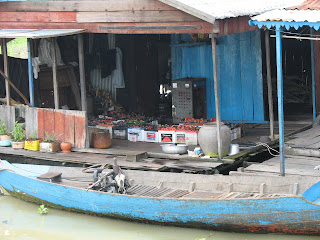
Over the course of the ride you see people living next to and on the water in ways that seem straight out of some whimsical fiction. The children along the way (and there are hundreds) scream "hello" and wave like parade queens and marshalls. I think the boat passing is the high point of any day. On our first trip we saw floating pig pens tethered behind floating houses; huge, hand-built bamboo fishing contraptions that raised and lowered a net suspended from a long boom; floating stores/barbers/other businesses; trees hacked to just above the water line for firewood for cooking....it was surreal. We left Battambang just after dawn. The Khmers (Cambodians- almost all of whom use the boat as transport between watery villages) ride down below in the seated area. The tourists all ride up on top to enjoy the view.
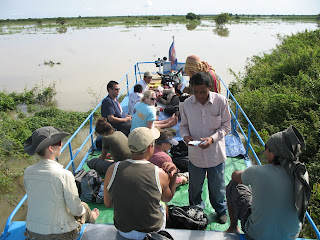
Often, the captain threaded a path through flooded scrub growth. We saw lots of channels and how he knew which to take was a mystery. At one point, we had to share the lane with this boat of Muslims. Apparently there are many living and fishing in the area.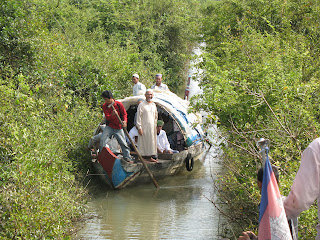 They were all smiles.
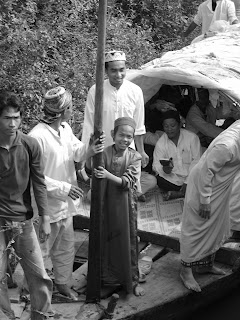 Sometimes we had to duck the overhanging branches. My shoes almost got swept overboard.
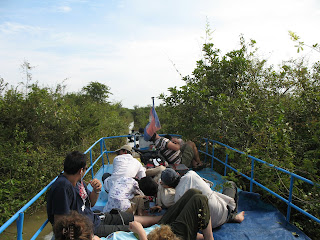 We realized after the first good strafing that the branches were home to innumerable red ants. For a long time everyone alternated between ducking branches, sweeping ants off the deck and brushing frantically at their clothes. No more relaxing sunbathing. It was hilarious.
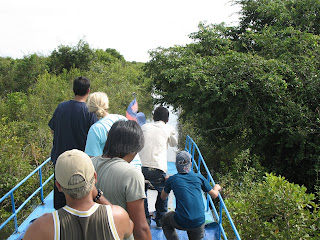 We were happy we survived that part.
 At villages where a passenger was getting off or on, a canoe would row out to meet our boat. It was like an aqua version of a Greyhound bus coming to a small town. Family members and friends seemed really happy to see one another.
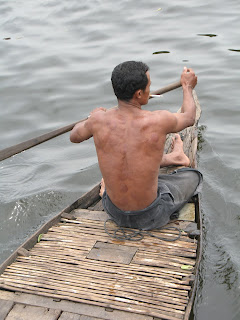
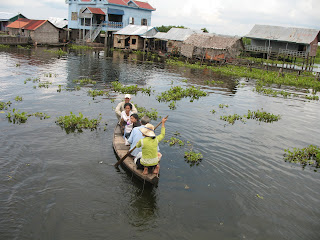 If you worked as hard as this dude all your life, you might look this tough.
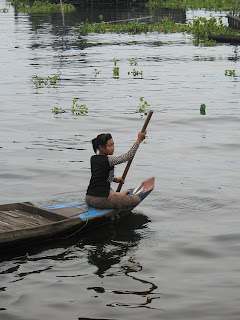
 Life on the water seemed to be just as beneficial to some of the ladies. Is that a mermaid tail she's sitting on?
 Even out here TV has its irresistible appeal. What the heck they can receive, though, I have no idea. It's REMOTE.
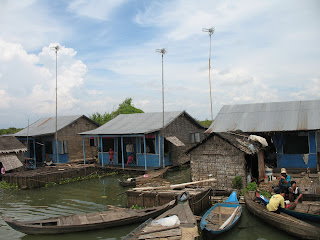 Everyone has a boat. All the boats have batteries. As a matter of fact, batteries are what power those TV's or any electric lights. A common business seems to be a battery recharging station. Got generator?
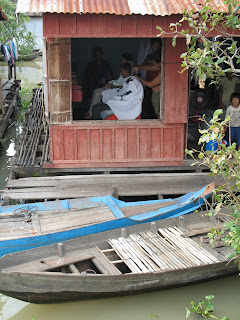
 A little off the top?
 This is a super-sweet ride. If you're ever in the area, check it out. Here are more photos from both our trips: http://destinationasia.myphotoalbum.com/view_album.php?set_albumName=album33
Over the course of the ride you see people living next to and on the water in ways that seem straight out of some whimsical fiction. The children along the way (and there are hundreds) scream "hello" and wave like parade queens and marshalls. I think the boat passing is the high point of any day. On our first trip we saw floating pig pens tethered behind floating houses; huge, hand-built bamboo fishing contraptions that raised and lowered a net suspended from a long boom; floating stores/barbers/other businesses; trees hacked to just above the water line for firewood for cooking....it was surreal. We left Battambang just after dawn. The Khmers (Cambodians- almost all of whom use the boat as transport between watery villages) ride down below in the seated area. The tourists all ride up on top to enjoy the view.
About an hour and a half into the trip, this guy came through to check our tickets. So, what would he have done if we didn't have one? LOL

Often, the captain threaded a path through flooded scrub growth. We saw lots of channels and how he knew which to take was a mystery. At one point, we had to share the lane with this boat of Muslims. Apparently there are many living and fishing in the area.
 They were all smiles.
 Sometimes we had to duck the overhanging branches. My shoes almost got swept overboard.
 We realized after the first good strafing that the branches were home to innumerable red ants. For a long time everyone alternated between ducking branches, sweeping ants off the deck and brushing frantically at their clothes. No more relaxing sunbathing. It was hilarious.
 We were happy we survived that part.
 At villages where a passenger was getting off or on, a canoe would row out to meet our boat. It was like an aqua version of a Greyhound bus coming to a small town. Family members and friends seemed really happy to see one another.
 If you worked as hard as this dude all your life, you might look this tough.
 Life on the water seemed to be just as beneficial to some of the ladies. Is that a mermaid tail she's sitting on?
 Even out here TV has its irresistible appeal. What the heck they can receive, though, I have no idea. It's REMOTE.
 Everyone has a boat. All the boats have batteries. As a matter of fact, batteries are what power those TV's or any electric lights. A common business seems to be a battery recharging station. Got generator?
 A little off the top?
 This is a super-sweet ride. If you're ever in the area, check it out. Here are more photos from both our trips: http://destinationasia.myphotoalbum.com/view_album.php?set_albumName=album33
Tuesday, October 02, 2007
Stasis
Checking in from Cambodia where the rainy season is beginning and the temps have finally fallen into the sub-molten range. It's been almost ten months since Tami and I first came to this region. Southeast Asia has been fun and interesting. We've spent time in Thailand, Cambodia, Vietnam, Laos and China (even made it over the border into pre-uprising Burma for one day).
Two days ago, we crossed back into Cambodia. This time, we're going to stay put for awhile. A couple of months back we started searching for volunteer positions and we've just been placed in Phnom Penh. We're excited because we really enjoyed Cambodia our first trip through back in January. The Khmer people are super-friendly and charming, especially the kids.

The country's just civilized enough that you can be comfortable, but twisted enough that you can dip into plenty of experiences that you'll remember for a long time. (See the delicious fried crickets and tarantulas below.)

It's got nice coast and beaches.

It's got ancient ruins that are simply superlative. I've never seen any more inspiring on this planet.

If all goes as planned, we'll be in Phnom Penh for the next three months. We're excited. We'll be volunteering/working for an organization (Kiva) that makes micro-loans to very small business people. I have a feeling we're going to learn a lot.
Something about this particular stop feels different - like we've reached the farthest extreme of our orbit. As with all other good things, our time on the road feels like it might be coming to an end. Plans can always change but, after Phnom Penh, we expect to turn our sites slowly toward home. From Cambodia we plan to go back to India for a few months and, barring any irresistible temptations . . . . we should be back in the States by early summer.
Friday, September 28, 2007
It isn't all bad
Yeah, I can whine about Bangkok. I watched this today, though. Beautiful.
 Under this huge, traditional swing, a woman fed the pigeons.
 She gave me a warm smile when I walked up.
 Who's flying?
 The Thai's do this prayer-like salute called a 'wai'. She held the bread between her hands and wai'ed before every broadcast.
 Happy birds and a happy bird feeder.
 Under this huge, traditional swing, a woman fed the pigeons.
 She gave me a warm smile when I walked up.
 Who's flying?
  The Thai's do this prayer-like salute called a 'wai'. She held the bread between her hands and wai'ed before every broadcast.
  Happy birds and a happy bird feeder.
Thursday, September 27, 2007
Phewww . . . Bangkok
Tomorrow we finally leave this city. Including our visits last December, we've spent almost four weeks in Bangkok in the last ten months. I can honestly say, there is little I will miss about it. A comparably dubious honor belongs to only one other city in this region, Saigon. Let it be known: the two huge commercial/population centers of SE Asia are not for me.
This isn't to say you can't have fun here or that Bangkok doesn't have its highlights. You can and it does, but they come at a high cost. First and worst is the pollution from vehicles. In this case I'd have to rank smog and sound as equally damning.

Bangkok is a black sinus town. Spend only a day walking around and you'll see what I mean. I notice that I unconsciously draw the shallowest of breaths crossing intersections. Waiting for the bus I stand as far back from the curb as possible.

Bangkok has its back alleys and, because Tami and I love to walk, we find and use many of them. The alleys inevitably end, though, dumping you back out on some clogged artery. If you're a walker, you're going to spend too much time scuttling along the edges of big, flowing rivers of smoke-belching steel. Even the all-too-rare green spaces are little islands buffered by little more than fences.

Motor vehicles have an equivalently negative impact on your ears. It's very tough to escape the cacophony. The main road fronting the block where our hotel sits is a huge boulevard, Ratchadamnoen Avenue - 12 lanes of buses, taxis, tuk-tuks, motos, cars, pickups and whatever else can be piloted to race from one stop-lighted intersection to another. Not only is there the raw physical threat to your body from merely trying to cross, the fumes here are especially tortuous. In minutes, my eyes burn. Just looking across a couple-hundred feet of air space you can clearly perceive the haze. The cumulative and non-stop roar of the traffic is like an industrial grand prix. Ratchadamnoen has become as much a psychological barrier as it has a physical one.
As I say, I won't miss much about this town. One sadly ironic inevitability though, is, if you're going to spend any significant time in southeast Asia, you're going to pass through Bangkok. And, because it's so huge and such and inertial sink, your to get stuck here for longer than you'd like. Oooof...
This isn't to say you can't have fun here or that Bangkok doesn't have its highlights. You can and it does, but they come at a high cost. First and worst is the pollution from vehicles. In this case I'd have to rank smog and sound as equally damning.

Bangkok is a black sinus town. Spend only a day walking around and you'll see what I mean. I notice that I unconsciously draw the shallowest of breaths crossing intersections. Waiting for the bus I stand as far back from the curb as possible.

Bangkok has its back alleys and, because Tami and I love to walk, we find and use many of them. The alleys inevitably end, though, dumping you back out on some clogged artery. If you're a walker, you're going to spend too much time scuttling along the edges of big, flowing rivers of smoke-belching steel. Even the all-too-rare green spaces are little islands buffered by little more than fences.

Motor vehicles have an equivalently negative impact on your ears. It's very tough to escape the cacophony. The main road fronting the block where our hotel sits is a huge boulevard, Ratchadamnoen Avenue - 12 lanes of buses, taxis, tuk-tuks, motos, cars, pickups and whatever else can be piloted to race from one stop-lighted intersection to another. Not only is there the raw physical threat to your body from merely trying to cross, the fumes here are especially tortuous. In minutes, my eyes burn. Just looking across a couple-hundred feet of air space you can clearly perceive the haze. The cumulative and non-stop roar of the traffic is like an industrial grand prix. Ratchadamnoen has become as much a psychological barrier as it has a physical one.
As I say, I won't miss much about this town. One sadly ironic inevitability though, is, if you're going to spend any significant time in southeast Asia, you're going to pass through Bangkok. And, because it's so huge and such and inertial sink, your to get stuck here for longer than you'd like. Oooof...
Burma? Myanamar? Call it what you want. It's bad either way.

Bangkok -
The news from across the border to the west of here is grim. Yesterday I read that troops in support of the military Junta that's ruled the country since 1988, opened fire on crowds with automatic weapons. Most of those in the streets peacefully protesting are Buddhist monks. The Guardian, of London, reports that less and less news is getting out of the country as the authoritarian regime is desperately trying to shut down all internet, cell-phone and international phone contact. One blogger, an exiled Burmese living in London has been blogging and posting photos sent to him from people inside the country: His Blog

This is big news here. There are an estimated million or more Burmese refugees living in Thailand. More chaos there translates into even more refugees here. Tami and I spent a week along the Thai/Burma border ten hours north of Bangkok. On one songthaew (a simple pickup truck taxi)ride, we spoke with a young guy who had not seen his father in 17 years. He said he'd led a union march in the capital in 1990. Afterward, soldiers came to their house, took him away. He's been in jail since. The only person allowed to see him has been the wife. The young man we spoke to had to leave Burma two years ago. He also had joined a peaceful protest. The police/army came to their home shortly after and he had to flee out the back of their house. He made it to Thailand and has been here since.
I'd like to be optimistic that Burma could see something like what happened in the Philippines toppling Ferdinand Marcos, South Africa with Apartheid or in countries in the former Soviet Bloc. Burma has a very popular, democratically elected leader, Aung San Suu Kyi , a Nobel Peace Prize recipient who's party won 58% of the vote in a nationwide 1990 election. The military rulers refused to hand over power, nullified the election and placed Aung San Suu Kyi under house arrest, where she remains.
Tuesday, September 25, 2007
Durian - My New Love
 Money in hand and eyes on the prize.
Some time ago I wrote about "firsts" and how they come less and less frequently as you grow older. Food offers lots of opportunities for firsts because there are so many freaking cuisines prepared around this world. Take out the preparation part, though, and food in its natural state is much more limited in scope. If you then subtract the animal kingdom - things like fried tarantulas, dog, beating snake heart, monkey brains, etc. - you're limited to grains, leaves, fruit or any other edible parts of plants. You can sample many of hundreds of kinds of mango, for instance, but even if they vary wildly in quality and character, they're still mangos. Discovering truly new and interesting food as a vegetarian isn't easy.
 Negotiating for a Little Globe of Heaven
About eight months ago, when we were first in Cambodia, we tried, just for the heck of it, the fruit called durian. I'd heard about durian for at least twenty years. I say "just for the heck of it" because the first thing people remark upon when describing the fruit is the smell. It was supposed to be a sulfury, sweet aroma that many people find unpleasant. Many places, notoriously Singapore, don't allow Durian on buses, trains or in many public places simply because of its aroma. 
Recently, Tami and I were told by staff and other passengers on a bus to stop eating the durian we'd brought along for the ride. Novice mistake. Once you taste it, though, and especially if you fall for it the way we have, you'll understand how we might have wanted to take it everywhere.
People get obsessed about durian. When we first arrived in Bangkok, there were two Australians going on and on . . . and on, sheesh . . . about durian. They'd just arrived and couldn't wait to find some to eat. I thought the woman was going to break into an erotic dance just talking about it. It was weird. The guy said he'd sometimes eat two a day when he had access to them.
That kind of behavior is not uncommon. Check out this guy's website: Durian Palace There are lots of sites out there like this.
Now, after getting familar with the fruit, I have repented and can understand why. I didn't even know something with such a complex and powerful flavor existed in an uprocessed state in nature. Like many new and challenging experiences, when we first tried it I wasn't sure I liked it. It's like the first time you try blue cheese or a single malt Scotch or the first time you heard Kid A by Radiohead. You weren't sure what to expect but what you got was like nothing you'd ever had.

For reasons we have yet to fully discern, durian seems to stir a certain kind of sinful indulgence. Vendors set up on roadsides and sell almost exclusively at night - often late into it when most all other vendors close. It isn't so cheap, either. We typically pay between 25 and 40 Thai Baht for a kilo - about a US buck a pound - but more than half the weight is waste. At the above stand, I met three women who had driven AN HOUR to get a rare variety of durian. Apparently it was pretty special. It cost 280 Baht a kilo - stratospheric in these parts!
We first sampled it a couple times in shakes. I'd walk along afterward thinking, "That was different. But, do I like it?" I'd wake up the a day or two later wanting to try it one more time just to see. Curiosity got the best of us and we bought our first whole fruit. Our room was filled with the sweet, fecund aroma. We cut into it and, for the next hour, tasted and mused on what other foods compared to it and what other foods it might combine with it to make new recipies. We thought about naming a restaurant after it and using a sillouhette of the fruit as the logo. We'd have durian dishes never seen before on the menu.

The fruit itself? The outside rind is covered in tough, sharp spines. Cutting into them is a craft in itself. The fruit's texture is kind of like an avocado crossed with a soft artichoke heart. It has a butterscotch flavor (especially when it's more ripe), some vanilla, some kind of subtle nut and (here's the part that most people would get sqeamish about, but it's the best reference I have) liverwurst. I know . . . . it sounds crazy but somehow it works. I am officially obsessed. It's hard to imagine not having access to this food once we leave. As I understand it, the US doesn't allow import of durian unless it's been frozen - and subsequently, completely ruined. I don't know, if it weren't for the fact that I want to go home to see my mother, we'd buy a house here and open a restaurant called Durian.
Monday, September 03, 2007
Only In America.....(unless you're not there)
 Celebrating Burning Man 2007 at Si Satchanalai, Thailand
For the ten years prior to coming on this journey, the end of every August found me making my way out to the Black Rock Desert ninety miles northeast of Reno, Nevada to participate in Burning Man. I never really had a doubt that the gathering was special. I'd never come across an event where so many people chose willingly to subject themselves to so much. If you want to attend, you face inclement weather, hard work, lack of sleep, usually significant out of pocket expenses among other discomforts.
Burning Man might not be for everyone, but it's come to be the social center of gravity for me and many of my best friends in San Francisco and further afield. Now, after being a spectator of two "Burns" from outside the United States, I see Burning Man in a context I couldn't have appreciated before - and I can see, more clearly than ever, how unique it is and how lucky are the folks who attend. There simply is nothing like it going on anywhere else.
 Tami and the Man, flanked by two Buddhas
The obvious distinguishing factor is that the large majority of the people on this planet simply don't have the discretionary wealth to spend on something like Burning Man. If you've attended, you know how much it can cost. When you're out there, you can see how much infrastructure and how much material and labor go into the art, to setting up the city and the large camps. The RV's many people drive to the Playa are far more luxurious and spacious than many family "homes" on this planet. What many camping Burners think of as adventurous outdoor survival for their week in the desert would be normal living conditions for hundreds of millions of people. How about time off from work? A majority of people on this planet don't have firsthand experience of what vacation time is, either. "A week in the desert to dance round the clock and look at art? Right..."
 Ariel View of Black Rock City (Eric Bong - 2004)
In addition to all the time we've spent in "developing" countries, we've also met a great number of traveling Europeans, Australians, Japanese and other people from industrialized countries. They have the wealth but they don't have anything like Burning Man happening. I'm not sure why. Few countries have the open space; especially publicly-owned open space the use of which is codified in law.
One disquieting difference we've noticed is that many countries don't allow their citizens the freedom to even conceive of such a collective, participatory and counter-cultural freak show. I put special emphasis on freedom. I bash the politics and governance of the US a lot but, the Patriot Act and the other encroachments foisted on us since 9/11 notwithstanding, Americans have been endowed with civil rights that are still the envy of many people on this planet. Go to a country like Laos or China and try to pull off a Burning Man event. The authorities would, without accountability to anyone but themselves say, "Ummm, I don't think so." And that would be the end of the discussion. If it wasn't people would get hurt.
 The "Belgian Waffle" (Nightshade 2006)
From afar, I also have come to recognize that Burning Man owes a specific debt to the colorful history of northern California and maybe San Francisco, in particular. Starting with some curious explorers (Sir Frances Drake comes to mind) and loads of fortune seekers, a lot of freaks have settled there over the years. Northern California has long been a haven for those who stand out because they look, think or behave differently. Extend that propensity for oddity out to an extreme and you can see something like Burning Man taking root.
We've covered a lot of miles and spent almost two full years in lands that fly many flags. Apart from maybe the citizens of India, I think if you dropped a typical person from most any country down in the middle of Black Rock City, they'd honestly think they were on another planet and have a breakdown
Of course until the nearest well-mannered Burners took them under their wing and helped them get sorted out. :)
Anyway, the whys and wherefores matter little. Burning Man happens. That it does is something anyone who's come to appreciate it should cherish. People do join in from all over the world. With luck, the whole lovely experiment will grow and spread.
Subscribe to:
Posts (Atom)
