Sunday, February 11, 2007

Don't Believe Everything You Hear


Woke this morning before sunrise to catch a bus. We're trying to get from the central highlands town of Kon Tum out to Hoi An, on the coast. Supposedly the bus companies have to pay more for insurance for westerners than Vietnamese so the price for the ticket (we were told) was almost twice that for locals. This happens a lot in Vietnam. After travelling for a while, especially in poorer countries, you get used to folks trying to make extra cash off your white skin. Fair enough, but we have to try to bargain. Also, after a while on the road, bargaining becomes part of the sport and even an obligation.
So, we argued...and argued - and as we argued, one bus after another left the station for various destinations - including ours. In many towns, there is one big, morning departure then only infrequent buses for the rest of the day. We had two local moto-scooter drivers (sort of a taxi driver) who shadowed us at every bus we queried and every time we went to the ticket desk. At first I thought they were sabotaging our effort to pay the local fare. Then I thought they were just trying to help us as our Vietnamese is very limited and English is almost non-existent. Everytime we'd struggle to ask about price, time and destination; the moto drivers started chattering in Vietnamese. The driver or ticket taker inevitably listened to them and told us there were either no tickets or gave us some riduculously inflated price. By the time the last bus left the station, I concluded the moto-jerks were, indeed, running interference and had stranded us. Hey, it happens. It hasn't happened much at all to us on this trip but here we are. After the station emptied, we ended up getting a normal ticket on the afternoon bus - our fingers are crossed in hope that they actually let us and our backpacks get on board. We found an internet cafe and are trying to fill some time. Let's see if we make it.

Tuesday, January 23, 2007

Aftermath


A final, belated note about Cambodia. You'd have a difficult time moving around in the country without crossing paths with some persons who've been physically maimed by war. The following is from the web site Mekong.net

  • "Unfortunately, one of the most lasting legacies of the conflicts continues to claim new victims daily. Land mines, laid by the Khmer Rouge, the Heng Samrin and Hun Sen regimes, the Vietnamese, the KPNLF, and the Sihanoukists litter the countryside. In most cases, even the soldiers who planted the mines did not record where they were placed. Now, Cambodia has the one of the highest rates of physical disability of any country in the world. While census data for Cambodia is sketchy, it is generally accepted that more than 40,000 Cambodians have suffered amputations as a result of mine injuries since 1979."


Click on the link and check out the rest of the history. It's a singular study in ongoing human suffering.

I add this information as images like these have been difficult to get out of my mind. Cambodia really won me over. Her people were the single biggest reason for that. Even after so much suffering, they live with a love of laughter uncommon in my experience.

Landmines are still manufactured and used widely in conflicts around the world. More often than not, they are placed in an area for some short-term war need, then left only to be stumbled upon years later by someone who had nothing to do with the conflict. If you want to learn more about landmines you can see the web page of The International Campaign to Ban Landmines.

Thursday, January 18, 2007

Really Cool


We have a friend back in the Bay Area who's done a lot of travel over the years. He's a genuine adventurer and when he goes out on the road he dives right into whatever experience is before him. I'm only guessing, but I'd say he's been traveling for almost as long as I've been alive. He's seen a lot and when you've visited as many parts of this world as he has, I think you get a more tempered perspective on what's exciting. This isn't to say he doesn't get thrilled or enjoy interesting experiences. Even now, he still travels more than anyone I know. I think he just feels less compelled to "sell" his excitement. If a place is worthwhile to visit, he'll say it's "pretty cool". If it's exceptional say, like Macchu Picchu in Peru, he'll amplify that to "really cool". It doesn't seem to matter if he's talking about someplace that might break and ordinary person's heart. If a place shouldn't be missed, he'll let you know with a "really cool".

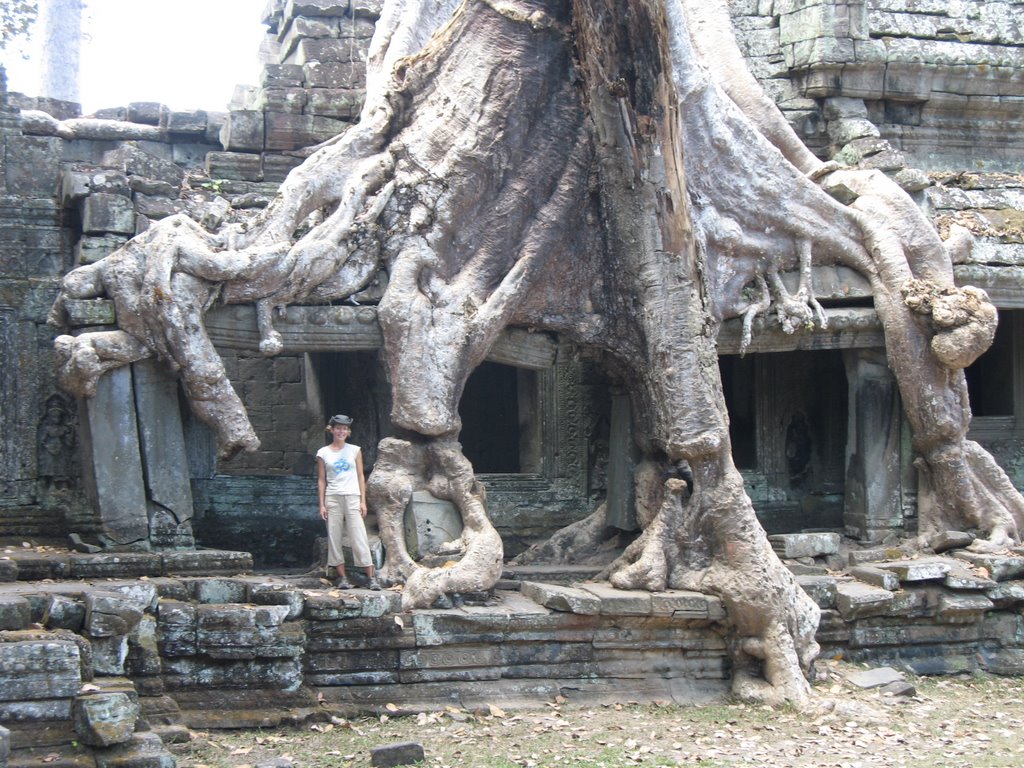
After a more than a year on the road seeing wonder upon wonder, the last week Tami and I spent wandering around the ancient ruins of Angkor. It was really cool.

Link to Angkor Photos

Tuesday, January 16, 2007

A Country of Hustlers and Jokers


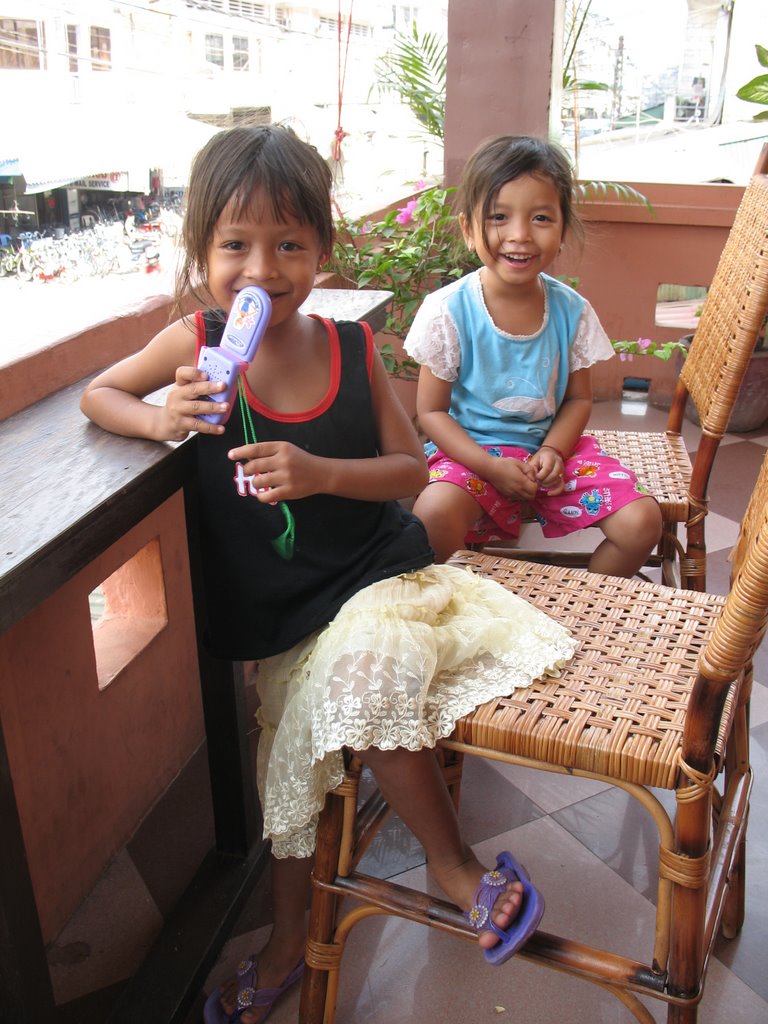
Around the ancient ruins of Angkor, the children are the most motivated vendors. Moreso than perhaps any place I've ever visited, the kids know how to work the charm. Their most effective weapon is their stylized use of English. The letter "r" changes to "ah", "v" changes to "b". Syntax gets modified so the kids sound a little like Yoda, from the Star Wars movies. Statements come out in a sing-song, rise and fall of the voice - the end always trailing away on an elongated, plaintive drawl.
  • "Buy one moah my beeah (beer)..."
  • "Gib me one moah orange again..." (From a girl who saw oranges in a small bag we carried. We had given her no oranges in the first place.)
  • "Buy my cold drinks, okayyy...?"
  • "Buy my post card nowww..."
  • "Don't say no, say yes..." (after I answered in the negative.)
  • "No? Buy twooo..." (after I answered that I didn't want one.)
  • "Hello Sah (sir). I sell you cheap, cheap big plan. Two Coke for one dollahhh..." (from a boy running up to us, menus in hand.)
  • One common tactic involved the kids trotting up the final twenty or so steps to us saying "hello" breathlessly. Initially, we asked them what was wrong. They'd answer something like, "I ran so far to catch you." It took us a couple times to realize this was a sympathy ploy for us to recognize their hard work.

I mentioned in the prior post that Cambodians seem to love to have a laugh, especially if it's at the expense of a 'falang'. One morning I saw this crude looking saw laying on some blocks. I thought it looked interesting so I clambered over for a photo. A small group of women workers eating close by took an interest and started talking. At first they watched me maneuver around the rubble trying to get a good angle. Two came over to look at my camera screen to see why the heck I might be trying to take a picture of a weed chopper. One woman sitting facing the group started a monologue that elicited periodic ripples of laughter and affirmations from the others. I could tell she was talking about me because she and the others would glance in my direction just before or after the laughs.

I got my shot and walked past. Her monologue continued without a break. Both she and the others tried to stifle increasing laughter. Since I was the obvious object of the joke, I stopped to watch. The monologue lady was laughing so hard she was rubbing her belly, gasping and wiping her eyes yet still she talked on. This had been building for something like two minutes. Just behind her, facing myself and the ladies, sat a small group of men groundskeepers. Throughout, the guys never fully shared in the laughs. After I stopped to watch, they only smiled nervously shooting me furtive glances I can only assume were intended to confirm, without a doubt, that I didn't understand what she was saying.

What entertainment I could have provided by merely taking a photo, I have no idea. I could still hear the laughs and the occasional "falang" as I rounded the corner of a ruin.

Sunday, January 14, 2007

Cambodia for Sale


Roadside, hand-filed keys.


I'm not sure what I expected of Cambodia. No other travelers we'd met said they really liked the country but none said they really hated it either. It made me curious how they almost all paused, thoughtfully reassessing their experiences to see if anything had changed since the last time someone had asked their opinion. We'd heard that it was 'lawless', a bit like the wild west, that you had to watch your back. I knew, like its neighbor Thailand, Cambodia had a thriving sex trade. I'd heard the legends about shooting ranges where you could fire off AK47's or grenade launchers. (True, even now.) We heard from more than one person that, if you wanted it, you can get it in Cambodia. The past half century has seen Cambodia struggle to get out from under the yoke of the colonial French, stagger from the horrific maelstrom of violence that flooded over from the U.S. war in Vietnam only to then fall into a ghastly genocide at the hands of the Khmer Rouge.

What we found after we arrived was a surprise, if a surprise can unfold slowly over weeks. I don't know that I've ever visited a country that confounds and charms the way Cambodia has. It's a scruffy land of hustlers who seem to love few things more than having a laugh at the expense of a "falang" (foreigner). Easy to obtain visas, low cost of living and the ability to live under the radar have drawn expatriates from around the world who've opened all manner of businesses, notably bars, restaurants or other entertainment oriented ventures. I didn't know Bogie's Casablanca still had modern day cousins but Cambodia seems like that kind of place.


  • You can rent scooters or motorcycles easily. Forget the helmet, though. Cambodians don't bother with those.
  • Traffic flow on the streets is akin to blood cells in a vein. Where there is space, bikes, scooters, cars or cycle rickshaws crowd into the lane until they can flow freely. At intersections, it's very common for the two-wheeled vehicles to cut the corner by cruising right through a gas station or parking lot without slowing.
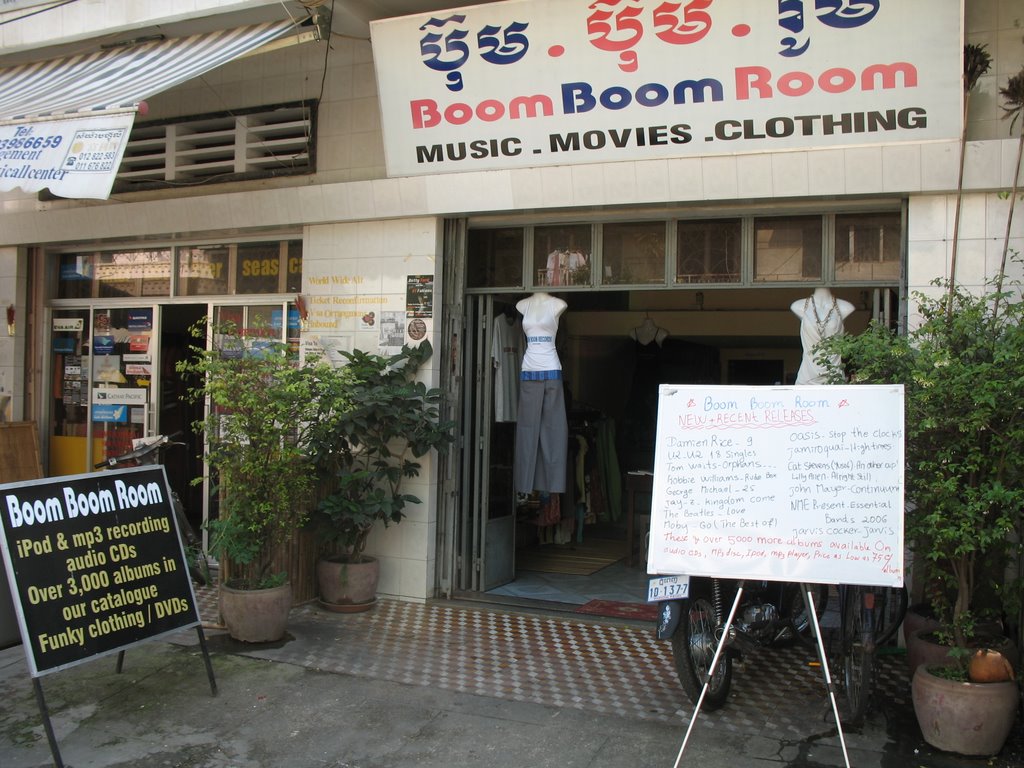
  • Books, the backpackers' great indulgence, can be had here for a fraction of what they cost even next door in Thailand. Cambodia puts little effort into copyright protection. There is a cottage industry re-printing (i.e. photocopying) books. DVD's and CD's can also be had for extra cheap. There is even a small chain of shops (see photo below) here that allows you to download MP3's to your audio player from "their" very extensive catalogue. For the local folks looking for Asian pop music, some enterprising Cambodians simply set up a computer, a monitor and some headphones on the sidewalk and allow people to plug in and get music right on the street as if it's a snack.
  • Sex for hire is as common as coffee here. It's an old, routinely accepted practice in southeast Asia. Some entrepreneurial expatriates put new spins on it, though. Down on the coast, Russian "investors" (i.e. mafia) opened a club where customers choose from girls who swim in a pool mermaid style or lounge with large snakes.

    A lady and a potential customer.

Saturday, December 23, 2006


(Written December 21st)

Link to current photos

Today marks a year since we pulled out of the driveway back in San Francisco. If you can remember that feeling you used to have when you were a child on the first day of summer vacation - you had all the time in the world ahead of you and you were free to do whatever you wanted - that was how I felt last December 21st. The following 365 days have not disappointed in the least way. I suppose some people roll their eyes at my or Tami's repetitive expressions of how grateful we are. Call me naive but I still feel it strongly.

After a full year of literally wandering the planet, we finally landed on a beach. We're on an island in the Gulf of Thailand called Koh Mak. In my mind, when you strap a backpack to your body and board an international flight, a tropical beach hovers confindently somewhere in the wings as the inevitable default destination. If you're lucky, you can find a beach with the right balance of calm serenity and comforts. Palm trees, sand and clear, warm water might be the comfort food of backpacking travel - perhaps of all travel.

Beach life is one of those parts of a big trip that you know is going to give you some low-impact, intimate interaction with nature. It's going to give you a sure chance to slow down. (And no jokes about what the heck do we need to slow down from...everyone needs a little beach chill in their lives from time to time.)
Koh Mak delivers. Actually, if Koh Mak were any more relaxing, I'd think it was fiction. Apart from a thatched hut on stilts, we virtually live outside. We can walk through huge groves of coconut palms swaying in the breeze. We get to submerse our bodies into the limpid ocean all day. Beers are cheap and very cold.

We may be in and out of touch for awhile. Tomorrow we take a boat for Cambodia. If the next year turns out to be anything like the last, we're in for lots of fun. May yours be that, as well.

Happy holidays and all the best!

Saturday, November 25, 2006

'Bye-bye to the Sub-Continent


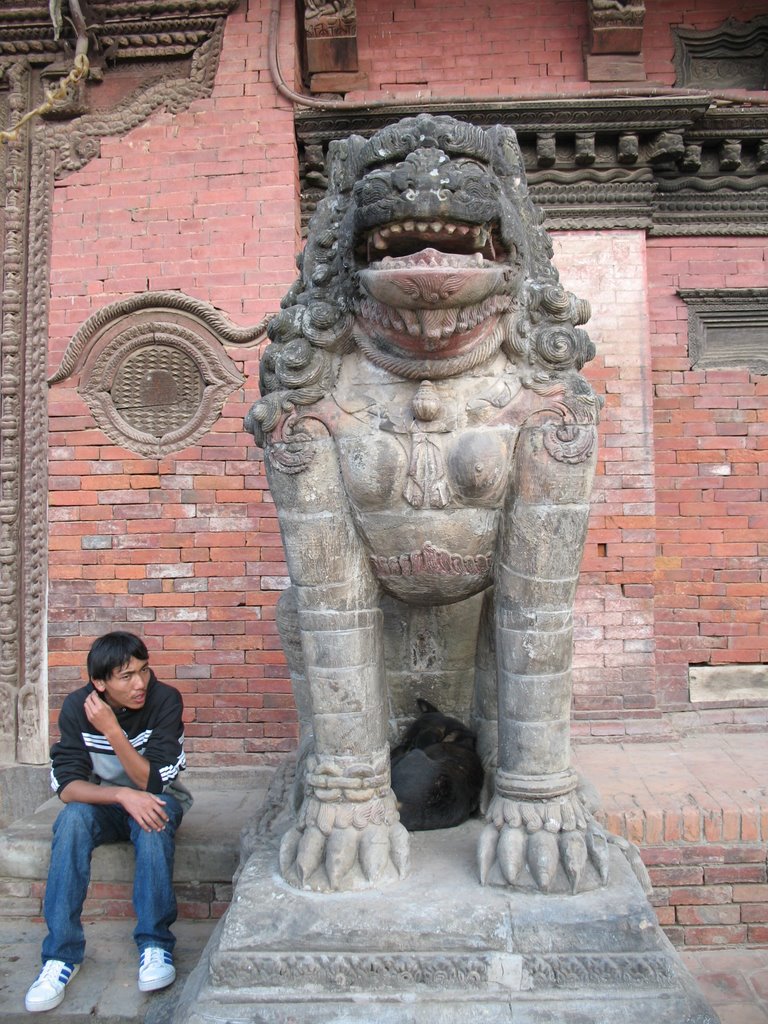
A lion stands guard as a boy and a dog share a rest.

Today is our last day in Nepal and the last, after nearly two hundred, in the area geographers refer to as the Indian subcontinent - the expanse bounded by the Himalayas to the north, the Bay of Bengal to the east and the Indian Ocean to the West. I rose early today for walk around Kathmandu's old central square trying to absorb every trademark impression; commit to memory in some tangible way all the sights, sounds, smells and any sensations that make the Hindu heartland special. When I force myself to acknowledge that these last hours are all that's left, my heart shivers at leaving behind this taxing but familial chaos.


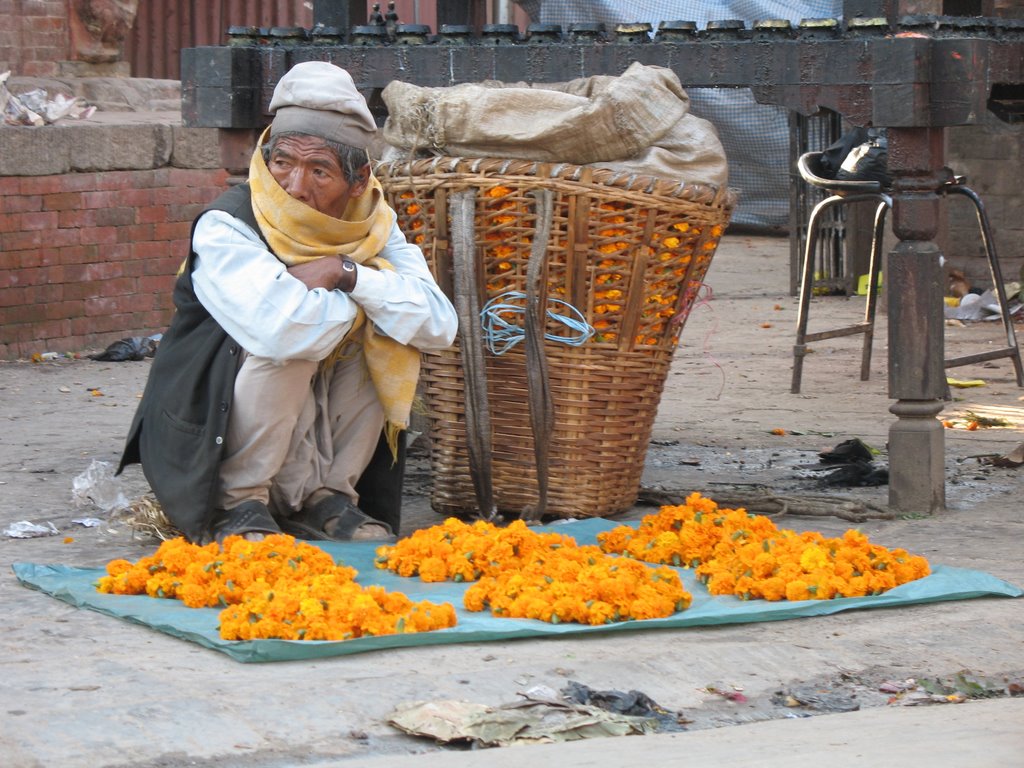
Puja (prayer) offerings for sale

At one of the many temples just after dawn the smell of the burning butter lamps and incense wafted all around. The devout stood in line to ring bells and hang chrysanthemums and daub colored tikka powder on the antiquated stone idols.

After the sun came up, I bantered one final and, as always, unpredictable time with the man - the clearly over-educated man - who, from before dawn to well after dark, squats on a very low wicker stool in front of a grimy kerosene burner making and selling tea to the students and merchants in the square in front of our hotel.


The best tea shop in Kathmandu

He combines his preparations with solicitations to all the passers-by with the frenetic energy of a trader on the floor of a stock exchange. Every day he finds time to intersperse our morning cups with pearls of humorous wisdom culled, if he's to be believed, from a life path more circuitous and full of surprises than I can guess at. I will miss his smile, his barking exhortations at potential customers and even the confusion I feel at not knowing which of his eyes to respond to as one wanders randomly in its socket the other bounding back and forth or up and down in rhythm with his animated head. I will certainly, certainly miss his tea.

I'm plotting how I might fit in one last taste of naan; chewy flat bread hot out of the tandoori oven. Before I leave I want to eat one last bag of Kurkure, the Frito Lay snack seen only in these parts because it's too spicy for anywhere else.

This has been a good time to be in Nepal. The government, such as it is after years of turmoil and fragmentation, has signed a peace agreement with an insurgent opposition group. The revolutionaries (that's really the only fair term for them) fought an eleven-year battle to dislodge the world's last Hindu monarchy who've ruled the country as a fiefdom for almost two and a half centuries. The good political news for Nepal started in April with a cease fire agreement and culminated last week with the signing of the peace agreement. Since then, the streets of Kathmandu have been filled with celebratory Nepalis buoyed with optimism that peace and more equitable opportunities might become the norm in their lives.

So, five countries in ten or so months. Tomorrow we move on to a new region. As when we pulled out of our driveway, before we left New York for Barcelona, departing Europe for New Delhi and, now, flying to Bangkok, southeast Asia projects the gravity of another major chapter. The warm weather, warm Thai people, fantastic Thai food and the beaches should, with luck, help make the transition tolerable.

'Bye-bye.

Sunday, November 05, 2006

360 Degree Wow (Pt. 3)

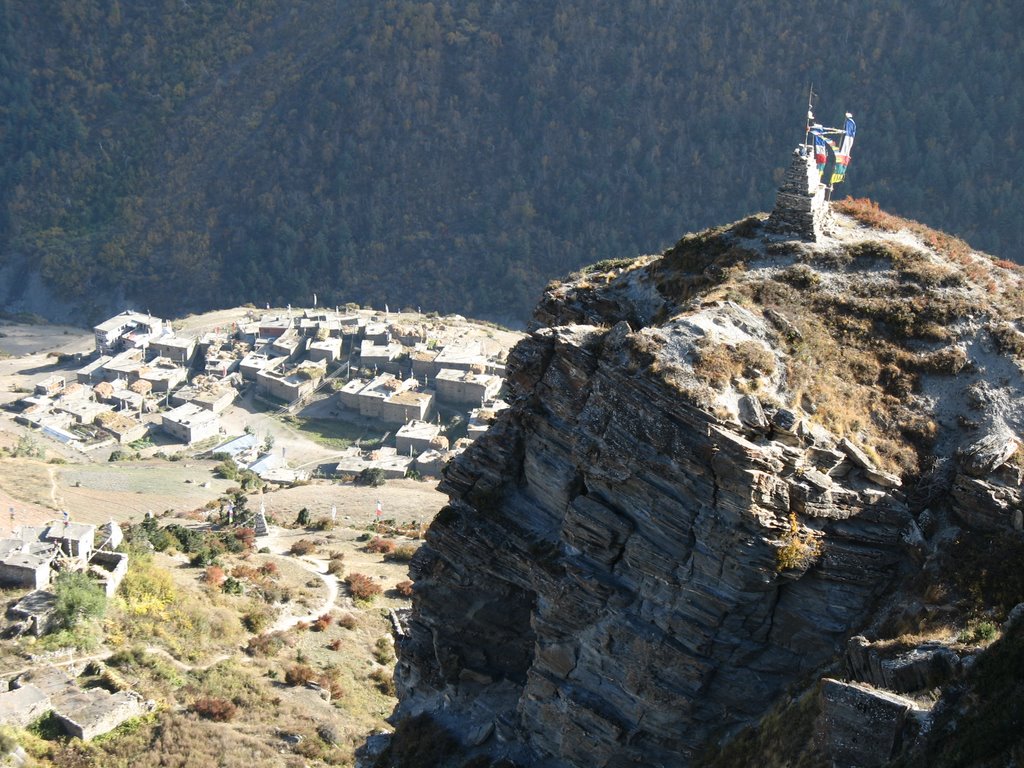
Khangsar from Old Khangsar

Link to current photos

Trekking evokes hiking in mountains through nice terrain and, with luck, interesting cultures. What we found out around Annapurna was an experience so dense with variation, so large in scale and still so fundamentally and sincerely different than our normal lives back home that Walt Disney or a Vegas impresario would be lost at how to wake people from their somnolent lives so effectively. Who're the lucky duo yet again? By the grace of the good heavens above, Tami and I.

We were lucky that, for the length of our trek, the work of fall harvest filled the valleys. Every day below treeline people swarmed over the terraced fields cutting, threshing, winnowing, drying and storing their provender for winter. By the latter stages, villages were starting to celebrate the succesful harvest with ritual festivals. In Marfa, the local monastery held a traditional dance. For a few days, buddhist monks wearing elaborate masks and costumes acted out scenes from ancient stories as villagers from up and down the valley came to watch. The excitement was like a local rock concert. The monasteries themselves could fill a traveller's description of the trek.

Buddhist iconography littered the valleys for most of our way. Long walls piled with carved 'mane' (mah-nay) stones, chortens, gates, prayer wheels, prayer flags and more added a reverant salute in celebration of the awesome beauty of these peoples' abode.

One morning, in Marpha, we awoke well before dawn to the sound of horns then drums coming from the monastery up the hill. The commotion continued until we were fully awake so we decided to roll with it and go see what was happening. We put on almost every piece of clothing and trundled out into the dark chill. Up at the gompa, three local lay women were performing what looked like the morning puja or ceremony. They walked around the perimeter of the building spinning prayer wheels, muttering "om mane padme hum" (hail to the jewel of the lotus within), and lighting the juniper smudge pot in the center of the courtyard. Three stories above, the tops of the four walls and, to the west, the mountains behind, framed the dawn stars. A huge spar rose up forty or so feet from the smudge and streamers of prayer flags stretched from its top to the surrounding walls. A monk in his red robes arrived to towel the wooden floor inside. None of them took even passing notice of two westerners standing quietly. The setting of this place of worship, similar to so many others we've seen in these mountains, makes me wonder if a spiritual practice or cosmology is possible without a tangible connection if not outright integration with nature.

I could go on but who has time to read so much? If you're curious, talk with us when we meet. Our excitement will be easy to tap. Those friends who do love to spend time in the mountains, put Annapurna, or at least Nepal, on your list. Sure, it's not like it "used to be" and I wouldn't say it's without faults. If done right, it sure as hell can be wonderful. Moreover, with 'development' working its own dark magic, it's not likely to get any better over time.

I'd kind of thought that I was starting to get saturated with travel experiences. This trek erased any ennui. Time seems to have slowed on this part of our trip. The month on the trail felt like a month. It didn't rush by in a flurry of discordant activities and logistical encumbrances. Many people we met on the trail, as I might have expected from outdoor enthusiasts, were people who'd I'd likely befriend at home. As time passed out there, I, for the first time in a while, worried less about politics, money and problems outside my control. For better or worse, the trip obliged me to live in the Present. At the very least, it's probably not unrealistic to guess that I may never be in this good of shape again.


Or have this much facial fuzz.

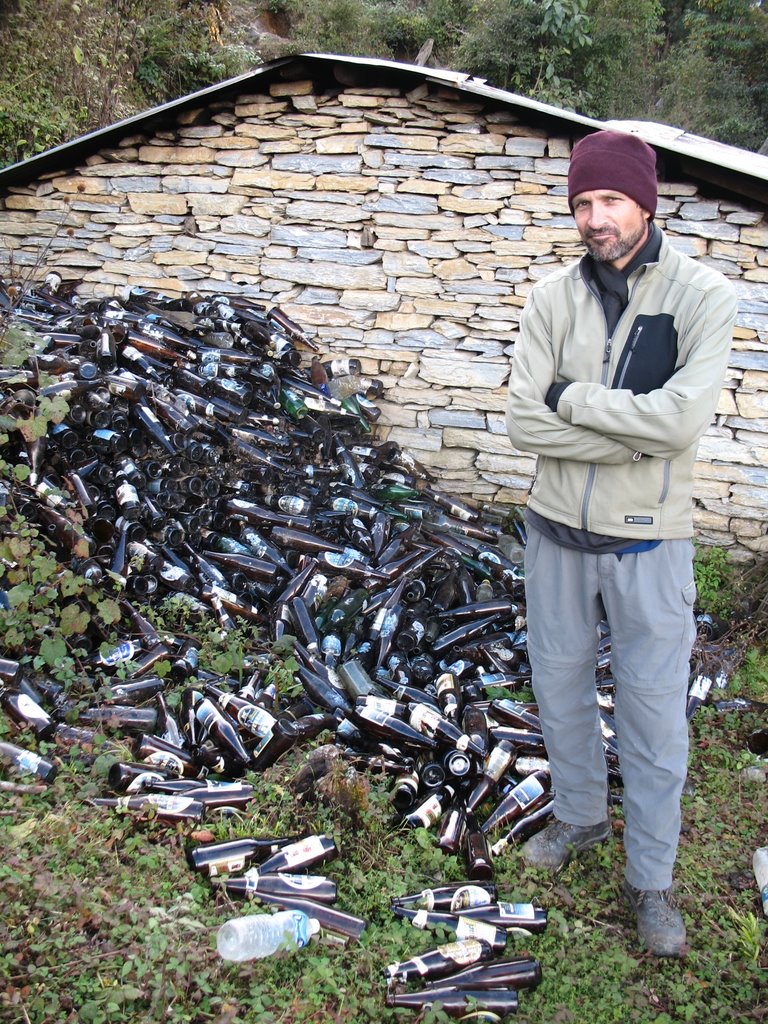
No, I did not drink all that beer.

360 Degree Wow (Pt. 2)

Some numbers:

  • 31 - Number of days on the Circuit
  • 175 - Approximate number of miles walked as we did the Circuit (including side and day trips)
  • 19 - Number of villages or encampments in which we overnighted
  • 2 - Number of nights we slept at a higher elevation than any peak in the US outside Alaska (14,600' and 15,840 respectively)
  • 3 - Approximate number of miles in elevation gained from the beginning of the trek to the highest point (2,592' to 17,769')
  • .97 - Approximate number of miles climbed during biggest single day of ascent (5,100' from Tatopani to Ghorepani) Ouch...
  • 10 - Approximate number of US dollars spent per person/per day on the trail

Link to current photos

The first three days we walked through tropical green hills and deep river valleys layered with rice terraces and surrounded by forest. Despite our daily yoga practice in Varanasi, our legs and lungs were pitiful matches for the foothills of the Himalayas. After ending each day more exhausted, we capitulated in the village of Jagat on our second night and contracted a porter to carry some of our things. Porters are an integral part of trekking and of living in these mountains. They comprise a class of laborer similar to trucker in the West. Well before recreational backpackers ever existed, let alone heard of Nepal, porters carried much of the trade goods that moved through this entire region. Due to the challenging nature of the topography here and what that means for 'development', they still do.

We'd been hiking from the start with two very bright and very nice Australian guys just out of college, Peter and Jonnosch.* Peter had a bad knee so he, Tami and I decided to offload some of our heavier things onto our new porter, Arundha. Thank heavens for that man. The next two days were tough uphill and, if it weren't for him, they would have been miserable. His fee when we parted ways was just over fourteen US dollars. That was good for him, actually, as we only loaded him maybe forty pounds of gear. Most porters contracted by tour groups make about $3.50 a day and carry twice that weight or more. I tried hefting some of the larger porter loads I saw and, no exaggeration, could barely get them off the ground. They told me they weighed around sixty kilograms (130 lbs.)!

On the fourth day we started to get closer glimpses of snowy ridges and peaks. The temperatures were lowering and the air thinning. It started to feel like the mountains. We pushed on for a long time as it was our final day with Arundha and we wanted to cover as much ground with his aid as possible. We also wanted to avoid Chame, the marquis tour group village that marked this stretch. Organized groups of 12 to 20 people - mostly from Germany, France and Spain in our encounters - platoon around Annapurna with their retinue of porters and guides in tow. When they descend on a lodge or guesthouse, their sheer numbers impart a kind of hegemony that is tough to escape. They take over a dining room so thoroughly that, if you weren't paying attention, you might think you were in the Pyrenees or the Alps rather than Asia.

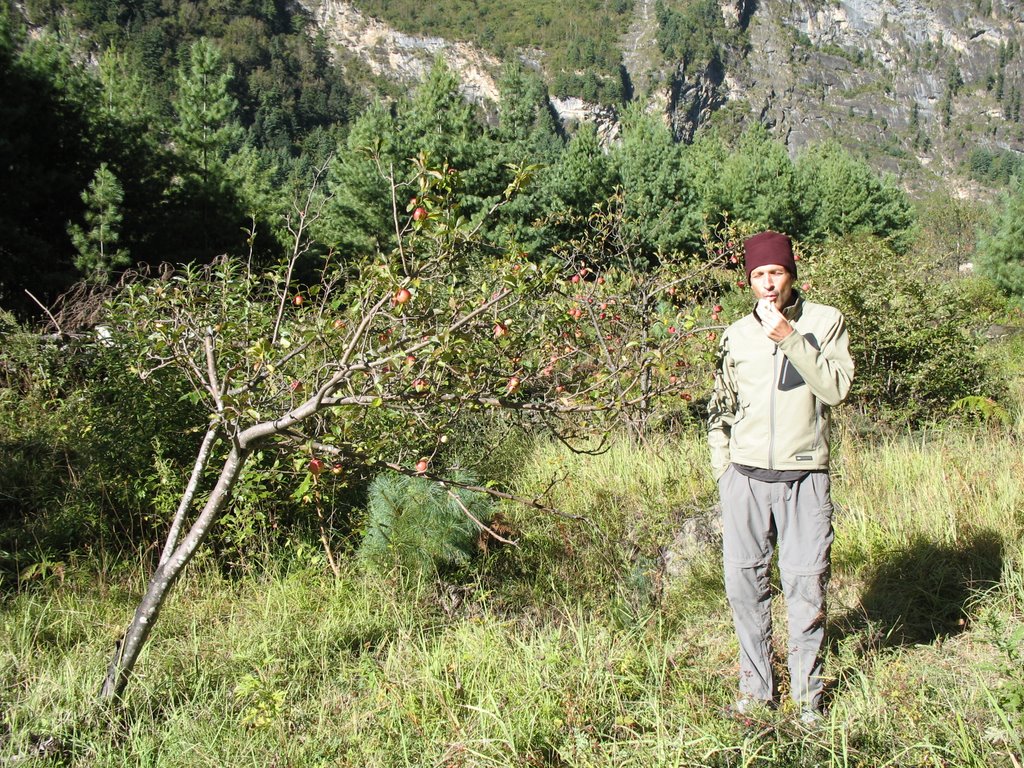
An hour and a half past Chame was the tiny village of Bhratang. We made for it but our energy and the valley light were failing badly by the time we reached it late in the afternoon. We'd only eaten a mid-sized breakfast and skipped lunch to make time. After about nine hours of climbing, we were famished. The trail approaching Bhratang was lined on one side by a long stone wall that shielded an apple orchard containing hundreds of trees. We'd seen almost no fresh fruit since we started the trail so I was surprised the trees still held most of their apples. From where we walked, I could see what looked like dozens of sizes and colors. My stomach lurched in a much different way than it had after the buffalo gore.

Our small lodge actually fronted the orchard and an old man squatted on the deck slicing a huge basket of apples for drying. As soon as I dropped my bag, I went back down to the manager and asked him, if we paid him, we could go into the orchard and taste from the different trees. Without hesitating he walked me back down along the wall, showed me the place to climb over and pointed out where his half of the orchard began. With the very whettest of appetites and an equally sharp knife, Tami, the two Aussies and I trundled down to the trees and commenced a feast. (Though it would be difficult to quantify, there is no doubt we burned more calories every day than we consumed. The net result is evident in our current emaciated appearance.)

We picked an exemplary specimen from each tree, quartered it, tasted with slow relish then moved on until we spotted apples that looked different and repeated the ritual. Each tree had unique fruit and virtually every one was better than any apple I buy at home. All were organic. Most all were too small or misshapen to make it into a supermarket bin. The flesh was often as hard and crisp as a potato but super juicy and bursting with flavor. The fourth or fifth tree we sampled stopped me cold. If I were stranded on a desert island and forced to pick just one apple , this was it; a thin skin that popped as you bit through, flesh that split under your teeth like crystals and a balance of sweet and tart that made me forget all other apples...forever. For a guy that is an avowed slave to his palate and stomach, I was in heaven.


(As a sidenote: Early on in our travels, Tami and I both read an excellent book called "The Botany of Desire". The author explores the history of Man's relationship with apples - and three other plants - in very interesting detail. I learned that all apples originated as knobby wild fruit not so far from Nepal in central Asia. The fruit we buy and eat today is much different and has changed drastically from its forebears. These apples of Bhratang were heirloom apples, closer in quality and character to their ancient relatives than anything I'd probably ever eaten.)

The sensory transition that began with the change of topography and climate and climaxed in the orchard, presaged satisfaction and joy that most 'practical' adults won't allow themselves to hope for out of fear of assured disappointment. On our hike the next day, the valley opened up to reveal Annapurna II, a glaciated peak three miles above us yet so close we could trace every foot of the incline directly from the ground we walked. That night we stayed in the village of Upper Pisang, the first of ten consecutive nights at which we slept at 11,000 ft. or higher. Apart from some modern consumer goods, intermittent electricity and plate glass, the villages we visited had not changed in hundreds of years.

Trekking evokes hiking in mountains through nice terrain and, with luck, interesting cultures. What we found out around Annapurna was an experience so dense with variation, so large in scale and still so fundamentally and sincerely different than our normal lives back home that Walt Disney or a Vegas impresario would be lost at how to wake people from their somnolent lives so effectively. Who're the lucky duo yet again? By the grace of the good heavens above, Tami and I.

* (I found out later that Peter, also unawares, walked up to the Buffalo killing just as the celebrants delivered the final hack. His description of what he saw was quite a bit more ghastly than my own.)

Saturday, November 04, 2006

360 Degree Wow

Well..that took a little longer than we thought. Not to worry, though. We're both safe and sound in magical Kathmandu trying to put a few pounds back on our scrawny bodies. What we thought was going to be a nice two or three week hike turned into a month + a day of hard work and rarely interrupted bliss. Where to begin....
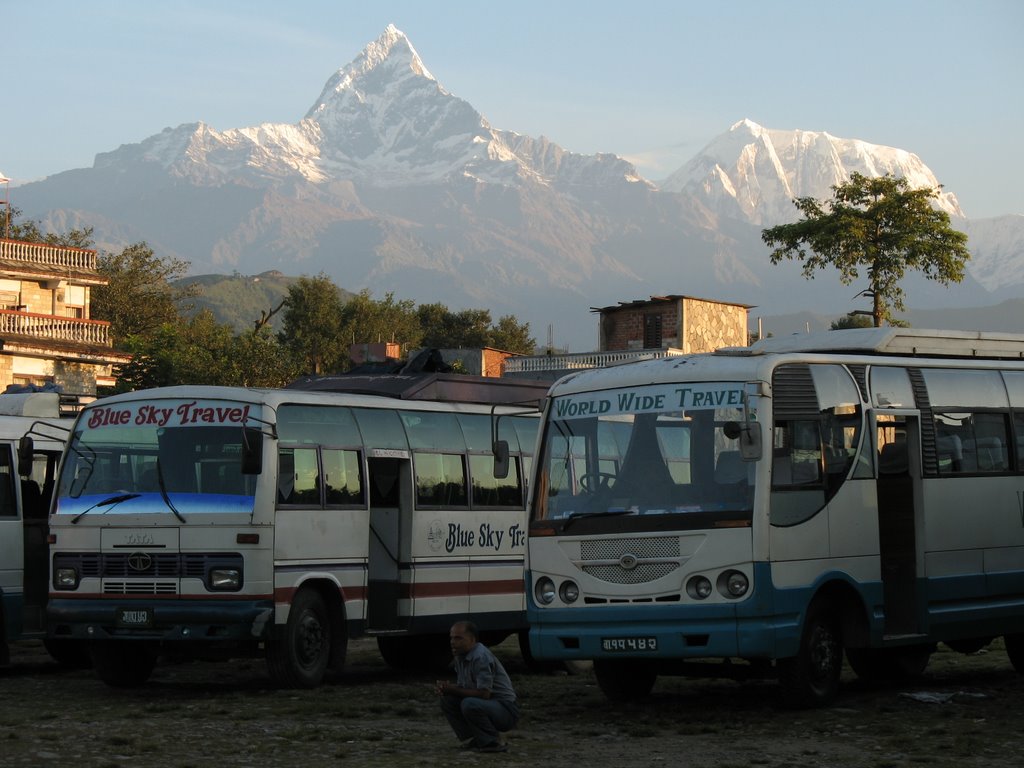
Morning Departure for the Trailhead

Link to current photos

I'm afraid some description will be lost on those who don't like to spend time in the mountains so first, a little context. Before we even made it into Nepal, we knew we would do at least one trek. The Annapurna Circuit was one among several possibilities but we'd heard grim stories of it suffering the ruin of its own popularity. Images of backpack and Gore-tex-clad Westerners lined up at narrow passes or cable bridges kept our thoughts tentative for this route. I'd heard about Annapurna before I got my first passport over twenty years ago and, even then, the area was already a well known destination for trekkers the world over.

The word 'trek' itself is an unfamiliar word to most Americans. We typically describe the activity as 'backpacking' which is partially correct. Within the setting of North America, mountain backpacking is pretty much limited to putting everything you need to survive into a backpack and heading out into the wilderness. In mountainous places that have been inhabited for far longer, mature settlements and even societies existed long before there were roads or cars. Populations are more dense and humans live, as they have for a long time, with an intimate relationship with the mountains. Much of the Nepal is populated like this and trekking through it yields a much different kind of experience. You still get the nature but you also get a cultural component that can be just as rewarding.

Barring Tibet, Nepal has the highest average elevation of any country on earth. The majority of its land slants either up or down some part of the Himalayas and travel, even now in more places than not, has been limited to those willing to do it on foot. Necessity gave birth to a well developed network of "roads" (trails, actually) used for trade. People either carried their goods themselves or loaded them on horses, donkeys or yaks. As trips can take days or weeks, every village had at least one inn or teahouse for travelers to eat and bed down for the night.

Nepal remained closed to the rest of the world until 1950 when its king, optimistic about the prospect of earnings from foreign exchange, agreed to let in tourists. In the late 1960's, budget travelers looking for unspoiled, off-the-beaten-track destinations stumbled upon the mountain trade routes and their teahouses and inns. Word spread slowly that you could walk among the most amazing mountains on earth with the added bonus of spending time in a culture minimally affected by Western development. By the time Tami and I arrived in Nepal the reputation had had the better part of four decades to spread far and wide. As I said, we were tentative if not outright skeptical.

We started our Nepalese visit in Pokhara, the traditional jumping off point for Annapurna. Arriving directly after five months in India and, more importantly, after three weeks in Varanasi -- pressure-cooker India distilled into one, very dense and intense city -- the refined calm and cleanliness of Pokhara's tourist area only increased our suspicion about overexploitation of the area.

On our first full day we decided to get some exercise by hiking up one of the lakeside hills to a huge stupa. It was hot and we couldn't believe how much we sweat but the views were nice. We knew the high peaks were to the north but, being the end of monsoon season, clouds shrouded that horizon all day. Then, as we started to go down, Tami stopped with an oath that most Christians would think mildly inappropriate. Above Phewa lake in front of us, above Sarangkot ridge a few miles beyond and above and much higher off the horizon than you'd think to look for land - or, as Peter Mathiessen says in the Snow Leopard, "...so high as to seem overhead"- a break in the clouds revealed a glimpse of the snow and rock pinnacle of Machhapuchhre. From the maps I'd seen, the Annapurna summits were twenty and thirty miles to the north. Macchapucchre loomed so big and clear, it looked no more than an afternoon's walk around the nearest hills. Then and there we both reconsidered our 'ban' on Annapurna. We were still at the very beginning of trekking season and since Pokhara had almost no other tourists yet, we reasoned the Circuit might not either. Two days later we were on a bus to the trailhead at Besisahar.

Events and observations can take on unintended portent prior to challenging and unfamiliar endeavors. Our bus ride coincided with one of the final days of the Nepali festival of Dasai. On this particular day, the faithful attempt to appease the goddess Durga with a ritual slaughter of some livestock, usually goat or buffalo. All along the five hour ride we saw fleeting and distant evidence of rural carnage. As I stepped off the bus and adjusted my backpack, I walked over to a group of twenty of so locals gathered in a circle at the side of the street. Over their shoulders I could see a young buffalo stretched between a few men pulling ropes from his back legs. His front legs and head were tied to some protruding re-bar stretching him prone to the pavement. In the next few seconds, a man standing beside the animal raised a large but very inadequately sized khukri knife mounted on what looked like a broom stick and drove it down on the buffalo's spine at the neck. I was in no way prepared for this. I heard a loud crack, saw some red where the blade struck and the men heaved against the beast's frantic struggling. Horror of horrors, the little blade did little more than bounce off the bone and tear the skin. I saw instantly this would be a prolonged, gory affair. I was five paces down the street before I heard the next chop.

My vegetarian stomach was still reeling five minutes later when, down a side alley, I saw two legless, headless and bloated buffalo corpses wafting smoke to the heavens. To remove the animal's hair, a man with a rag-bound torch on a stick was smearing kerosene over the hides. It's been over twenty years since I stopped eating meat and the smell of barbecues holds no nostalgia for me. I hurried faster toward the trailhead.

Did I think we were marching off to our own slaughter? Not at all. After India and Varanasi, the sacrifices of Dasai were really not so shocking. If anything, they helped to make me acutely aware of my present existence; more overwhelming than coffee and certainly more bracing than anything I'd imbibed over an adult lifetime, I was embarking on a long awaited trek, alert and appreciative of all that lay ahead.