Pokhara, Nepal
Tami observed that tomorrow will mark the first anniversary since we left our jobs. It seems especially auspicious (her observation, as well) that we depart on one of the epic hiking routes, the Annapurna Ciruit. (Note, I did say 'hike', not 'climb'.
What a year it's been. At the end of it I can only bow my head in thanks.
So, we'll be out of touch for anywhere between two to three weeks. Don't fret if we don't get back to you right away. We'll certainly be thinking about you.
Meanwhile, in the 'what will our legacy be?' department, this from yesterday's Washington Post...
Dan Froomkin - Bush Rules - washingtonpost.com:
Washington Post Link
"Today's Senate vote on President Bush's detainee legislation, after House approval yesterday, marks a defining moment for this nation. How far from our historic and Constitutional values are we willing to stray? How mercilessly are we willing to treat those we suspect to be our enemies? How much raw, unchecked power are we willing to hand over to the executive?
The legislation before the Senate today would ban torture, but let Bush define it; would allow the president to imprison indefinitely anyone he decides falls under a wide-ranging new definition of unlawful combatant; would suspend the Great Writ of habeas corpus; would immunize retroactively those who may have engaged in torture. And that's just for starters.... The people have lost confidence in their president.... Bush remains deeply unpopular... mistrusted... out of touch....
But he's still got Congress wrapped around his little finger. Today's vote will show more clearly than ever before that... the Republicans who control Congress are in lock step behind the president, and the Democrats -- who could block him, if they chose to do so -- are too afraid to put up a real fight. The kind of emotionless, he-said-she-said news coverage, lacking analysis and obsessed with incremental developments and political posturing -- in short, much of modern political journalism -- just doesn't do this story justice...."
One of their readers observed:
"This is bad. Very bad. I can't underscore how bad this is. This is our Fugitive Slave Act, our Sedition Act, our Korematsu. This is a danger to our domestic liberties and a terrifying threat to our national security--for its impact on our international standing and on our alliances may be terrible indeed."
Friday, September 29, 2006


Monday, September 18, 2006
Brother From Another Planet

Most rececent PHOTOS HERE.
Well, well, well...
Flirt with the gravity of Planet Burning Man and who knows what might come shooting out of the cosmos? Just after the festivities finished back in Nevada, I got an e-mail from Mark, a person who joined our camp, Garage Mahal, for the first time this year. He was on his way to India to meet a friend and wanted to see if we could cross paths. This isn't so easy, as India is just over a third the size of the US. Comparitively, he could have been flying into Missoula, Montana and we could have been in San Diego. Lucky for us, we were still camped in Varanasi which gave us a fighting chance because he and his friend both wanted to visit this city anyway.
After several e-mails trying to nail down meeting places and times, we finally hooked up. They checked into the same guest house as us....but, OOOPS, what's this? Their rickshaw (motorcycle-taxi) driver took them to a different Vishnu Rest House. (Funny side note: In India, to try to cash in on an existing business's success, competitors have NO reservations about naming a business after an established, successful hotel or restaurant. Upstart business make it known to all rickshaw drivers that the 'imposter' hotel will pay a 'finders fee' to any driver who delivers customers to their door. We have subsequently heard that there are as many as seven guesthouses in Varanasi with some variation of Vishnu in their names i.e. "New Vishnu", "The Real Vishnu", "The Original Vishnu", "Ganga Vishnu", etc.) Once we figured out that we were at different "Vishnus", Mark and Alexandra moved to ours. We had an excellent 30 or so hours hanging out until they hopped a train to Agra.
What a quick and surprising dose of "home"! Major kudos to Mark for such a well-timed and appreciated precision strike.

Wednesday, September 13, 2006
Wayyyy Over the Line
Some of you know that I spent several years working in the beer business. One of my roles at the company where I worked had to do with regulatory conformity. Perhaps the single most important part of this concerned what is commonly termed "label approval". The governmental body that has primary and almost sole responsibility for this is the Alcohol Tax and Trade Bureau (TTB) in Washington, D.C.
I'm not sure anyone would debate that alcohol's role in human history has been and continues to be turbulent....the swizzle that stirs the drink in certain circumstances, so to speak. Ever since prohibition in the 1920's and early 30's, the TTB has had an explicit restriction against making any "therapeutic claims" for alcoholic beverages. Basically, this means that a beer or wine company cannot claim, even implicitly, that their product can make you feel or perform (in any way) better after consuming it. I saw some ingenious attempts at circumventing or navigating, rather, the spirit of this regulation....the best of these, for better or worse, originating from my own company.
The most obvious (and terrifically worn out) tactic is to throw a few pretty and scantily clad women into your ads to make a man (men drink the vast majority of beer after all) think he might meet similar women if he drinks "X" beer. All the big brewers do this and it's long accepted that the consumer can draw his own conclusions regarding his own probability of meeting similar women.
When a brewer wants to communicate something that promises more 'efficacy', they have to take a more subtle approach. A typical ploy could involve sending a message to potential consumers that your product might enhance the male sex drive or make a drinker feel more masculine. Designers (not the company I worked for) might try to communicate this (and did, however ineffectively) by including the image of a Rottweiler dog on their beer can. In their print advertising they (again, not my company) might claim that their product could make you 'last till the dawn'. Most all efforts treading into this 'claim' territory are caught by the specialists at the TTB leaving a legacy of fairly straightforward communication based on brand and quality. Until relatively recently, even claims of alcohol strength were discouraged by the TTB.
Nonetheless, beverage marketers continually try to step just a little further over the line with the designs they submit in an attempt to get the upper hand on the competition thereby putting out a product about which they can build 'myth'. See, if you have 'myth', you can play on that to differentiate your product from all the others. But myth is a subtle thing and the dance the TTB does with it's constituent manufactures actually helps enforce a subtlety that, ironically, lends any embryonic myth credibility. In other words, because of the TTB's long record of managing therapeutic "claims", if a marketer went too far over the line in its claim, no consumer would believe the hype. Conversely, if a marketer got something through TTB...perhaps the 'word on the street' is true.
I have recently discovered, in India, they apparently regulate alcohol marketing by using somewhat different guidelines. The US beer market is relatively conservative. My experience allowed me to see plenty of interesting ads and labels that all pushed the envelope but all that was within an admittedly prudish marketing environment. My horizons have now been broadened and I have now, offically, seen EVERY LAST THING...


 And if you had any doubt at all...
I'm not even sure what this communicates. I am, however, absolutely certain that I will avoid drinking "Fire" at all costs.
I'm not sure anyone would debate that alcohol's role in human history has been and continues to be turbulent....the swizzle that stirs the drink in certain circumstances, so to speak. Ever since prohibition in the 1920's and early 30's, the TTB has had an explicit restriction against making any "therapeutic claims" for alcoholic beverages. Basically, this means that a beer or wine company cannot claim, even implicitly, that their product can make you feel or perform (in any way) better after consuming it. I saw some ingenious attempts at circumventing or navigating, rather, the spirit of this regulation....the best of these, for better or worse, originating from my own company.
The most obvious (and terrifically worn out) tactic is to throw a few pretty and scantily clad women into your ads to make a man (men drink the vast majority of beer after all) think he might meet similar women if he drinks "X" beer. All the big brewers do this and it's long accepted that the consumer can draw his own conclusions regarding his own probability of meeting similar women.
When a brewer wants to communicate something that promises more 'efficacy', they have to take a more subtle approach. A typical ploy could involve sending a message to potential consumers that your product might enhance the male sex drive or make a drinker feel more masculine. Designers (not the company I worked for) might try to communicate this (and did, however ineffectively) by including the image of a Rottweiler dog on their beer can. In their print advertising they (again, not my company) might claim that their product could make you 'last till the dawn'. Most all efforts treading into this 'claim' territory are caught by the specialists at the TTB leaving a legacy of fairly straightforward communication based on brand and quality. Until relatively recently, even claims of alcohol strength were discouraged by the TTB.
Nonetheless, beverage marketers continually try to step just a little further over the line with the designs they submit in an attempt to get the upper hand on the competition thereby putting out a product about which they can build 'myth'. See, if you have 'myth', you can play on that to differentiate your product from all the others. But myth is a subtle thing and the dance the TTB does with it's constituent manufactures actually helps enforce a subtlety that, ironically, lends any embryonic myth credibility. In other words, because of the TTB's long record of managing therapeutic "claims", if a marketer went too far over the line in its claim, no consumer would believe the hype. Conversely, if a marketer got something through TTB...perhaps the 'word on the street' is true.
I have recently discovered, in India, they apparently regulate alcohol marketing by using somewhat different guidelines. The US beer market is relatively conservative. My experience allowed me to see plenty of interesting ads and labels that all pushed the envelope but all that was within an admittedly prudish marketing environment. My horizons have now been broadened and I have now, offically, seen EVERY LAST THING...


 And if you had any doubt at all...
I'm not even sure what this communicates. I am, however, absolutely certain that I will avoid drinking "Fire" at all costs.
Friday, September 08, 2006
Exile on the Ganges
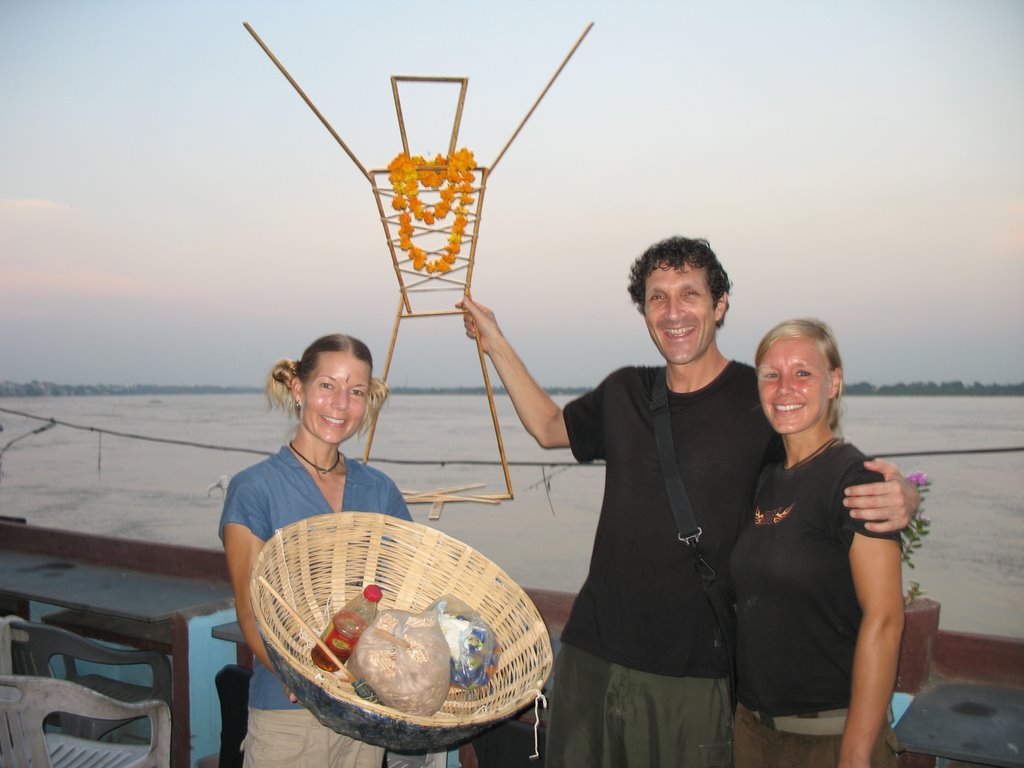 Burn Night Foursome (Tami Quest, The Man, Holiday and Claudia)
Planet Burning Man swung into Indian orbit and we were able to catch a ride, even if only briefly. Perhaps it was a case of being in the right place at the right time or maybe (if you're a believer like me) the spirit of the Playa can be tapped anywhere as long as the good citizens of Black Rock City have come together in fun-loving convocation. If it's the former, Tami and I sure are lucky. Varanasi is one fortuitous waypoint for a co-celebration. There is much about this ancient city on the Ganges that complements the ethos of "letting go" found in late August on the Black Rock Desert. Western preconceptions about personal space, cleanliness, decorum and sometimes, sanity get called into question continually.
The main reason Indians come to Varanasi, though, is to be released from mortal life. I can think of few endeavors of comparable sacredness. As a non-Hindu, non-Indian, I feel privileged to spend time here to watch and learn about the ephemerality of human existence. When you sit above one of the cremation platforms, the continual flow of bodies borne by family and friends to a final passage leaves little room for illusions of clinging self-importance. Some lessons transcend borders and culture, though, and my time with my fellow Burners has bequeathed me a few insights about graceful liberation of my own. Armed with that wisdom, Tami and I plunged into some of the ritual celebration that makes Varanasi special and gave it our Black Rock best.
We came up with the idea to co-celebrate about a month ago. (See this post.) Our invitations to other exiled Burners posted on Lonely Planet's chat site and Burning Man E-Playa yielded a nice handful of encouraging messages from around the globe but no respondents were in the vicinity of Varanasi during the actual event. That didn't slow us down a bit. Each day as you were on the Playa, we talked about you and whatever you might be doing. From 12,000(+) miles we were able to get right into the rhythm of things.
When we arrived in Varanasi, we set to work building our own "Man" and craft to float him down the sacred river. Actually, I had visions of sketching out a man and giving to plan to a local carpenter but after one surprisingly frustrating, three-way (interpreter included) exchange at a building supply store, I could see the chance of getting what we wanted was slim. That evening, I walked all over the old city of Varanasi scouting materials to build him ourselves. The first breakthrough came in the form of a large woven basket. I thought I could use that as a boat. After that, the other pieces fell into place. Our work area was the terrace of our guest house immediately overlooking the Ganges. Very, very nice.
I won't go into too many of the details here. Our Burn photos tell some of the story and Tami covered the unfolding events wonderfully on her blog. We burned our man a few days after the main event back home. That worked out perfectly as our burn night had a full moon, a partial lunar eclipse and a cast of supporters both in our boat and on the shore. After a few hitches, the Man burned better than we'd hoped. As you can see, it was a rousing success. :)
Link to our Burn Photos
The important thing I want to communicate is this: At the appointed time (Burn night for you, the next morning for us), each and every one of you, our Burning Man friends, whether you were on the Playa this year or not, had your name spoken aloud on the banks above the Ganges. Call it a prayer, if you will. For a short while this past weekend, you were with us in a special place.
A year from now, chances are slim we'll be either in Varanasi or in Black Rock City. Perhaps the question at the beginning of this post is correct also with the second answer. With luck, we shall find out.
Thanks for another great Burning Man.
Now......bring on the photos so we can see what kind of trouble you got into!
Thursday, August 31, 2006
Random Notes From the Gangetic Plain
- Yesterday I watched a man chase a cow down an alley. The man was cruising (and cursing) at top speed. The cow held a sturdy box the size of a large microwave high in his mouth and trotted faster than I assumed possible for such a big beast. The cow had apparently absconded with the box which belonged to the man and, as I've seen on many occasions here, was trying to eat it.
- Last night I stood on the roof of our hotel and watched flock after flock of green parrots fly into the grove of large trees in the center of Khajuraho, the town we've been visiting. The 'migration' starts about the time the evening sun hits the horizon and continues unabated for a good 30-40 minutes. The parrots, emerald green with the long tail feathers you might know from your pet store, flew in groups of twenty-five to well over a hundred. I'd never seen anything like it before. The flocks came in from the countryside and they just didn't stop. Parrots are loud birds and as the main roosting flock grew, all of Khajuraho was immersed in a cacaphony of squawking. There were easily over a hundred thousand birds. You can see the evidence on the walks beneath the trees today. Eww...
- In a couple hours we get on a bus to Varanasi, holiest of Hindu cities. It'll be at least fifteen hours across the Gangetic Plain of north central India. Ouch. The last time I was in India, I was so fascinated by that city I made the effort to go a second time at the end of my trip. Probably no single place has made a stronger impression on me. I'm eager (and a bit apprehensive) to return.
Tuesday, August 22, 2006
Size Matters

Link to newer photos. New ones start on page two of this album.
So we went down to Agra last week to see the sites. I did the same thing twelve years ago and suffered no diminished excitement at a second visit. Tami and I have seen a lot of amazing things on this trip but I knew the Taj Mahal was superlative and was as excited to see her response as I was to see the monuments. In fact, as we sat on the roof of our guest house watching the sun set on the Taj's wasp-waisted white dome and minarets, I realized there was maybe only one human-made structure on the face of the planet that resonates as deeply as the Taj...and we saw that one back in April in Paris. Now were going to see the other.
You can take all the Empire State buildings, Macchu Picchus, Acropoli, St. Peter's Basilici and Big Ben's and even pyramids of Giza you want. I think I even mentioned in an earler post that Barcelona was building another Taj Mahal. Antoni Gaudi and Barcelona are good...but they aren't quite that good. Seeing the Taj Mahal is one of those rare experiences that lives up to all (and I mean all) the hype you may have ever heard. That says a lot because no building in world has been surrounded by more myth and hype than the one in the above photo.
In fact, the Taj evokes such powerful emotional responses that I'd be hard pressed to think of any single work, building or otherwise, that surpasses it in its ability to inspire. The dome and the minarets dominate Taj Ganj, the village that surrounds it. Many of the guest houses and restaurants have rooftop seating taking advantage of their unique treasure.

Most people who have not visited the Taj don't realize that it's the centerpiece of a large, extremely complementarily beautiful complex. I remember stopping in wonder at the main entry gate my first visit. I had no idea I would get to see other structures of such awe inspiring size and graceful beauty. As you move toward and look through the opening in that gate, your sight toward the Taj itself is compressed down to a pin hole scope where you see, a few hundred yards distant, the Taj itself. The thing that struck me first was the people walking on its surrounding terrace. Those people were small...which made me realize that the Taj was big....really big.
And you know what...in art, you get extra points for size. The best art, in my mind, inspires you to want to be a better person. Whether or not you agree with the style or intent, if it's done superlatively, you have to give that to the creator(s). You can walk into the Louvre and see the Mona Lisa and it can inspire. But you check out Mona Lisa for fifteen minutes or a half hour and you move on. You walk into the Taj complex and (first, you cry...) you can spend days. From a distance the symetry, proportion, color and repetition of forms entrances you. Up close, you can see the flawless stone work, specifically carving and inlay, that covers the entire exteri (Incidentally, there is a fairly popular but...barely drinkable beer here called "Taj Mahal". I remember thinking that anything taking the "Taj" name should hold itself to the same, unsurpassed standards of quality. Everyone in India would be an alcoholic, though, so I'll have to let "Taj" beer slide on this one.)
The Taj Mahal is 351 years old as of last week. In 1655, the Pilgrims were still trying to get a foothold on the eastern seabord of the US. The Taj, built solely of stone, still looks as fresh and incomparable as ever. The Mughals and their craftspeople built a lot of nice things in India but they never got it so "right" as they did with the Taj. Apart from some fun loving Parisian riding the cresting wave of industrial modernization, I don't think anyone else has either.
Sunday, August 06, 2006
The Big Miss
 Homesickness....
Up until the past week or so, missing home has manifest itself as the occasional pang of longing. In a reflective moment I'll remember how nice it was to enjoy a proper beer or a passable wine, the fun surprise of standing at a party and have PleasureSean walk in and hand you a CD of new music or the liberating feeling of having your own kitchen where you can make whatever food that happens to sound good rather than take yet another gamble on the skills of a local cook. Things like those do make me miss home but you can take the longing in stride. Something comes up at this time of year, though, that for me...at least for the prior decade...has defined late summer: the final run-up to Burning Man.
Just like any major, annual happening, you always know it's out there in orbit. About two weeks ago, though, I could feel it in my bones. From ~12,000 miles away, it pulls like a migratory call. I could smell the Playa dust as my friends pulled their gear out of storage. I remember the added stress (and satisfaction) at work as you try to get everything organized for the time away. We see the e-mails flying around for everyone who's going and, for the first time, I'm really sad to not be in (at least one part of) my old life. Those who've had the very lucky fortune to partake of the giving and sharing that takes place at Burning Man have tapped into and helped to grow something that is valuable beyond quantification. The community that we share in Black Rock City doesn't come often in life. If you're lucky, you might find a similar depth of connection in your family or close group of friends. The openness and acceptance you find at Burning Man, though, have a different quality because people make a choice to make the long trek out there and endure the same potentially harsh conditions that you do.....because they know the effort is all worth it.
From a great distance, I'm happy to say, Burning Man looks even better. For the most part, Tami and I have been an isolated, little two-person caravan. We meet other travelers but they come from many different places and all walks of life. That's good for variety but you can meet a ton of them before coming across someone you think could make a deeper connection with. Out here, making those connections is even more difficult because everyone is on the move. Most meetings are brief and the potential of any friendship left speculative.
If you've been to Burning Man, you know that something happens in the weeding-out process where the liklihood of meeting a person of complementary mind and soul is much higher than your normal, day-to-day life. So what does that tell you????? If you don't make those kinds of connections or get to be a part of that kind of community most of the year at home.........and, from our perspective out here in backpacker land, community is even harder to cultivate.......you sure as heck should cherish the opportunity to partake of it when you can.
 I've always said I didn't think I'd be able to be anywhere within striking distance of Burning Man and not attend. Now, from such a long way away, I miss it more than I might have guessed. The good news is, Tami and I aren't conceding anything. We decided to celebrate concurrently with our own "burn" in Varanasi. If you know anything about Varanasi (it's all about fire, spirituality and letting go), you'll understand what a perfect place it is to be if we can't be at Black Rock City. We posted an invitation on the Lonely Planet and Burning Man discussion sites. Whether we have anyone join us or not, know that we'll be right there with any of you on the Playa in real time sharing our all.
Saturday, August 05, 2006
Random Notes on Cross-Pollinization

- We're in Dharamsala/McLeod Ganj right now. The area defined by these two towns is renowned as the home of the Tibetan govt. in exile. Back in 1959, after years of increasing repression of Tibetans and pressure on their leaders, the Dalai Lama had to flee for his life. The government of India offered Dharamsala as a place of asylum. (Tibet History) It's refreshing to stay among the less hectic Tibetans. They've created a small, mountain oasis of Buddhist restraint amid Indian boisterousness. One shortcoming about the setting, though: Dharamsala sits at about 6000 ft. on a ridge at the southern edge of the Himalayas. During July and August, the Indian monsoon bumps up against the mountains and the clouds pour rain down incessantly. I read in the paper that this area received 1450mm (~58 inches) in July alone. That's almost double San Francisco's annual rainfall. Very damp....and I have the nasty cold to prove it. I noticed today that much of our gear is starting to mold. It's time to move on....
- Both the native and traveler populations have adapted well to the inclement weather here in Dharamsala. There are lots of activities to do indoors out of the rain. They have meditation and yoga classes, lots of restaurants, internet cafes and movie houses, among others. For the first time since we left San Francisco, we've jumped into movie watching since it's A) cheap [about $.70 a movie] and B) dry inside the theaters. By theater, I mean a small, ramshackle room that will seat about 20 or 30 people with the movie shown on a wide screen TV. We've focused more on Tibetan documentaries since we're going there in a few months and these films are a good source of information. However, since the subject matter of these films, reflecting actual Tibetan events, is unfailingly sad, we see the odd Hollywood flick, as well. The moguls in Los Angeles would be disappointed to know that we can watch the same films you do within days of their US release. I'd heard about the practice for some time, but Dharamsala is the first place I've seen the end result. Someone out there in "first-release land" (the US) uses a video camera inside a theater to illicitly record the movie as it's shown. They then load the pirated film onto a computer and put it on the Internet for other people to download and burn into a DVD. Somehow it feels appropriate that the first film we saw that was an obvious copy was the new"Pirates of the Caribbean". We could tell it was pirated because the dialogue was out of synch and the sound and image quality, generally, were terrible. The clear give away were the sub-titles (English, in this case, for those in the audience who didn't understand 'pirate talk'). A non-English speaker sitting at a PC must have quickly slapped up whatever dialogue seemed to "sound right" as a "translation" and the results were often funnier than the film. Example: Something like, "I don't know where he is." became the sub-title, "It's wireless." Silly.
- Sometimes the quality of the copy is fine...but that doesn't make comprehending the film any easier. Last night we watched the new film with Ed Norton, "Down in the Valley". If any of you out there have seen it, can you please explain it to me? Specifically, the ending......? TIA.
- In the realm of entertainment, one more note: The former WWF, now "World Wrestling Entertainment", it H-U-G-E here in India. I've seen guys all over the country wearing 'Stone Cold Steve Austin', 'The Rock' or even outdated 'Hulk Hogan' t-shirts. You wouldn't believe how many boys and young men have asked me who my favorite wrestler is. TV's, even in remote villages, show "Smack-Down's" or "Summer Slams" every other night. How many programs does this WWE organization crank out? Ouch...
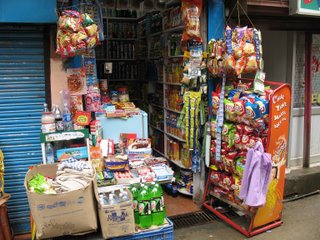
- Also, on the subject of American exports, consumer snack foods and soft drinks have become dominated by the big-two from the US: Pepsi-Co. and Coke. This is a marked change since I was here twelve years ago. There used to be a bewildering variety of Indian products in every little store. Some are still there but they share much of their former shelf space with the above two plus Wrigleys (gums), Cadbury and M&M Mars (candy bars) and others. Coke had actually abandoned the Indian soft drink market back in the 1970's (they refused to comply with an Indian requirement to "Indianize" their shareholdings to at least 40% Indian). They came back in the late 1990's to a more liberalized India where Pepsi already had a fairly dominant presence against domestic brands such as "Thumb's Up" and "Mirinda". Well, Coke's 100% US owned subsidiary bought all of Pepsi's competition and, now, it's just the two globals fighting it out with their respective portfolios. I have to say it's weird to see Indians drinking "Mountain Dew", a product named after a barely remembered euphemism for the do-it-yourself efforts of Appalachian bootleggers. The snack shelf is where Pepsi-Co. (their subsidiary, Frito Lay, actually) shine. As in the US, they don't just dominate the shelves, they went out and bought new ones to ensure proper display of their wares. Even in India, a small shop owner can find a place for a wire shelf display dedicated to one brand. It'll be interesting to see what, if any, Indian brands survive the onslaught.

Tuesday, July 18, 2006
See For Yourself
(Written about a week and half ago.)
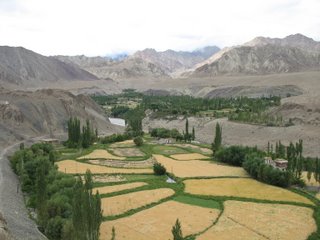 Alchi, Ladakh
Link to current photos.
Tomorrow we leave for Kashmir. As of today, we've spent three weeks in Ladakh, longer than any single place since we pulled out of our driveway back in December. In the time we've been here , the potato fields that were green when we arrived, have started to flower en masse. This seasonal tick of nature's second hand was the kind of chronology I sought as I sat at my desk at work. In San Francisco, seasons are so subtle that, if you spend most of your time indoors as I did, you can look out a window and guess blindly where you're at on the calendar. This can be shockingly disorienting for anyone with a sense of his mortality. I play a game now where I try to think back over the preceding months and remember where we were on the nights of the full moon. Good memories are made like this.
Ladakh, sitting on the militarily sensitive border with Pakistan, has been closed to all but Ladakhis and the Indian army prior to 1974, the year it was opened to tourism. Politics played as big a part as economics in the change of policy change. Some observers speculate that Ladakh was opened to tourists primarily as a measure to cement the validity of India's claim on a land that, culturally, is very different from the nation that exists in the huge land south of the Himalayas. Ladakh is one of those red-headed stepchildren in the hastily cobbled geography left by the retreating colonialists. For this reason and its mountainous isolation, Ladakh was unique in that it remained relatively untouched by Western industrialization or materialism.
This uniqueness raised some questions which fed into a continuation of a discussion with Shawn from the prior post. He asked if it is ethical to "travel in an area known to be teetering on the edge of famine?" I don't think his description was meant to apply to Ladakh (which currently suffers no shortage of food) but to other places he referred to in the developing world. It's of no matter, though. After I reflected on his question it became clear to me that a person of the US, if he or she is able, has an obligation to travel to countries in the developing world. I think each and every person should get the hell out and see what life is like in places where people live with their hands never far from their proverbial mouths. A person can learn some things about compassion, humility and gratitude that can't help but make them better.
The example of Ladakh is useful because here, you can still see something that is simply too complex to grasp in the Western world: a complete model of the natural resource systems that are needed for humans to live. I say still because even Ladakh is changing quickly and this insight will get more difficult to appreciate if development continues as it currently is.
Before 1974 and for centuries prior, Ladakh was a fully self-sufficient area. People sent trading caravans over the high mountain passes to other areas for a few things like salt but, for the large extent of what they needed to live, Ladakhis produced it themselves. They made their own clothes with wool from their sheep and natural dyes from plants and minerals. They saved some seeds from each year's harvest for future planting. They made houses out of poplar logs, adobe bricks and mud stucco. They cooked over dung fires. They fertilized their fields with human feces collected in composting toilets that was mixed with ash and wood shavings. It was a society with, literally, no waste.
With the introduction of the military and later, tourists; packaged goods, electricity, diesel jeeps and trucks, manufactured clothes, commercially grown food and other products from an industrializing India; the closed-loop system that sustained the Ladakhis throughout their history started to unravel. The results range from the obvious to those that are indiscernible to outsiders but all, to some degree, are destructive. If you walk anywhere in Ladakh, you will see the discarded plastic packaging of snack foods candy, laundry soap and on, and on. The Ladakhis never had a need for sanitation trucks and landfills and the introduction of these goods comes with no direction as to the proper disposal of their wrappings after the consumption of the contents. Ladakh, a network of fragile, high-mountain, desert ecosystems nutured with centuries of irrigation, terracing and careful planting, is becoming a plastic-filled mess.
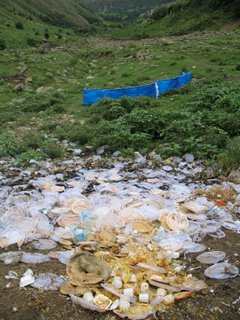
Roadside Waste Disposal
My point is not to blame the Ladakhis for being litterbugs. I could also talk about the use of pesticides that are banned in the Western world or genetically engineered seeds (those are here as well). I could talk about how large trucks carry subsidized (and non-native) food into Ladakh from the southern plains rendering local agriculture economically unsustainable and the valley air smoggy. The point is, that for most of their history, Ladakhis could see the end result of virtually all of their decisions and actions. They knew exactly where their food came from. They knew if they needed to build another house where all of the materials could be obtained and who would help them build it. For over a thousand years they lived in a large collection of green, reasonably prosperous valleys. Now, after a few decades that is rapidly changing.
The young people have little interest in working the farmlands. They are drawn to the 'glamour' and wages of the tourist trade. From what I could see, a good portion of that precious and very limited farmland is being given over to the building of an astonishing number of new guesthouses for tourists. I wonder, if the need should ever arise, they'll pull down the houses to grow food. I've seen the same changes around any number of cities in the Midwest or the central valley of California. Useful farmland, for all practical purposes, permanently entombed under huge subdivisions courtesy of shortsighted planning commissions and Pulte or KB Homes.
A place like Ladakh is a microcosm of our natural world and what makes it a destination worth visiting is that, here, you can see the results of what happens when a person makes a decision about consuming something. If you use certain things, there will be costs and waste. If you want to eat, you wait for the seasons to work their magic on the fields and, if you're lucky, you grow what you need. Most importantly, you can see and have an innate understanding that those resources that sustain life are not infinite.
At home, in the States, you don't see the costs. The plastic we use goes into a landfill but it doesn't go away. You use that same plastic or pump some gas into your car but, unless you're getting uncensored news from inside Iraq, you don't see the human suffering caused by securing the petroleum needed to make the plastic or gas. While that nice farmland outside Ann Arbor is being paved for another subdivision of McMansions, in places like Nevada or Idaho, you have massive industrial farms that exist because land there is cheap and agribusiness uses subsidized water to farm in earth that is nothing more than a sponge for natural gas derived fertilizers and oil derived pesticides.
But we've always been able to look away from those "costs" is we dont' like what we see. The garbage goes into the ground. If you don't like living in Saginaw or Stockton, you move. Costco and Sam's Club don't run out of lettuce or Tide or strawberries so why worry about how they get to the store. Detroit keeps making huge gas hogs so they must know something about the oil supplies, right? Politicians, news commentators and even some 'scientists' tell us we have nothing to worry about with respect to the environment or oil supplies. What to believe....?
I keep hearing that technology will keep coming up with solutions to resource issues. Well, here I am in Ladakh, an area in the nascent stage of being "developed" in the Western style and the resultant problems of material consumption look just as bad if not worse than every other place that had to go through "development". It's two thousand and freaking six and we still can't even deal with potato chip bags and clean water! If ever there were a time to bring some of that technology to bear, it is now and here. Yet, apart from a few, small, underfunded, non-governmental organizations working to stem the tide of consumption and waste, it's business as usual in Ladakh...which, I can assure you, will lose what makes it unique if this continues. And, if a small place like Ladakh with a long history of sustainable self-management can't continue to live within its resources, how in the hell will the rest of the world?
Helena Norberg-Hodge, a linguist who has lived and studied among the Ladakhis since the area opened, says that "In the West, our arms have grown so long that we don't know what our hands are doing." Visiting a place like Ladakh or Sudan or Guatemala or most any other "undeveloped" country helps to remind and illustrate for us that, for every comfort, there are costs. The question is, how long can those costs be sustained? "...it has been calculated that if all the worldÂ’s people had an American standard of living, two more planets the size of Earth would be needed to support them." That's tough to get your head around but, if you spend some time in a place like Ladakh, you can extend the logic out from what you see....and maybe it makes sense.
None of the above is new info to a lot of people. I am one more person sounding the "sky is falling" alarm. I would love to go to my grave a "Chicken Little". I will not bet that direction, though. Perhaps one more voice bouncing around the echo chamber of human consciousness will help more people to see, despite what Dick Cheney or Bill O'Reilly say, we are headed for trouble and we'd better look for ways to change. Places like Ladakh have shown us some of those ways and if you have any interest, you can come see for yourself.
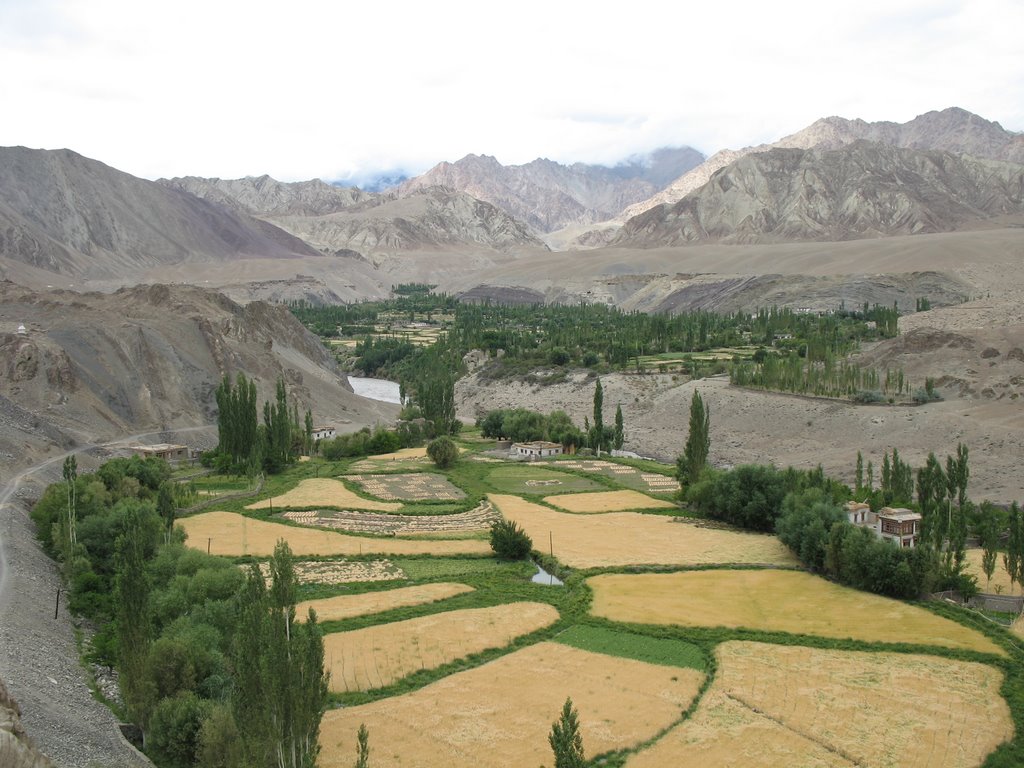 Alchi, Ladakh
Link to current photos.
Tomorrow we leave for Kashmir. As of today, we've spent three weeks in Ladakh, longer than any single place since we pulled out of our driveway back in December. In the time we've been here , the potato fields that were green when we arrived, have started to flower en masse. This seasonal tick of nature's second hand was the kind of chronology I sought as I sat at my desk at work. In San Francisco, seasons are so subtle that, if you spend most of your time indoors as I did, you can look out a window and guess blindly where you're at on the calendar. This can be shockingly disorienting for anyone with a sense of his mortality. I play a game now where I try to think back over the preceding months and remember where we were on the nights of the full moon. Good memories are made like this.
Ladakh, sitting on the militarily sensitive border with Pakistan, has been closed to all but Ladakhis and the Indian army prior to 1974, the year it was opened to tourism. Politics played as big a part as economics in the change of policy change. Some observers speculate that Ladakh was opened to tourists primarily as a measure to cement the validity of India's claim on a land that, culturally, is very different from the nation that exists in the huge land south of the Himalayas. Ladakh is one of those red-headed stepchildren in the hastily cobbled geography left by the retreating colonialists. For this reason and its mountainous isolation, Ladakh was unique in that it remained relatively untouched by Western industrialization or materialism.
This uniqueness raised some questions which fed into a continuation of a discussion with Shawn from the prior post. He asked if it is ethical to "travel in an area known to be teetering on the edge of famine?" I don't think his description was meant to apply to Ladakh (which currently suffers no shortage of food) but to other places he referred to in the developing world. It's of no matter, though. After I reflected on his question it became clear to me that a person of the US, if he or she is able, has an obligation to travel to countries in the developing world. I think each and every person should get the hell out and see what life is like in places where people live with their hands never far from their proverbial mouths. A person can learn some things about compassion, humility and gratitude that can't help but make them better.
The example of Ladakh is useful because here, you can still see something that is simply too complex to grasp in the Western world: a complete model of the natural resource systems that are needed for humans to live. I say still because even Ladakh is changing quickly and this insight will get more difficult to appreciate if development continues as it currently is.
Before 1974 and for centuries prior, Ladakh was a fully self-sufficient area. People sent trading caravans over the high mountain passes to other areas for a few things like salt but, for the large extent of what they needed to live, Ladakhis produced it themselves. They made their own clothes with wool from their sheep and natural dyes from plants and minerals. They saved some seeds from each year's harvest for future planting. They made houses out of poplar logs, adobe bricks and mud stucco. They cooked over dung fires. They fertilized their fields with human feces collected in composting toilets that was mixed with ash and wood shavings. It was a society with, literally, no waste.
With the introduction of the military and later, tourists; packaged goods, electricity, diesel jeeps and trucks, manufactured clothes, commercially grown food and other products from an industrializing India; the closed-loop system that sustained the Ladakhis throughout their history started to unravel. The results range from the obvious to those that are indiscernible to outsiders but all, to some degree, are destructive. If you walk anywhere in Ladakh, you will see the discarded plastic packaging of snack foods candy, laundry soap and on, and on. The Ladakhis never had a need for sanitation trucks and landfills and the introduction of these goods comes with no direction as to the proper disposal of their wrappings after the consumption of the contents. Ladakh, a network of fragile, high-mountain, desert ecosystems nutured with centuries of irrigation, terracing and careful planting, is becoming a plastic-filled mess.
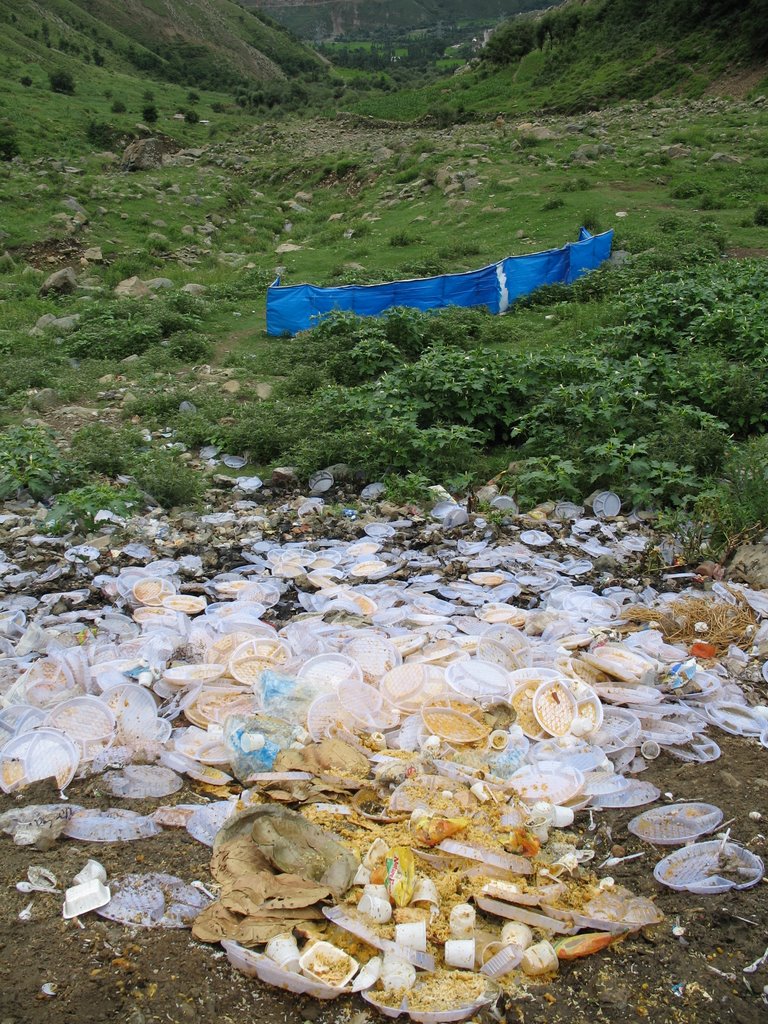
Roadside Waste Disposal
My point is not to blame the Ladakhis for being litterbugs. I could also talk about the use of pesticides that are banned in the Western world or genetically engineered seeds (those are here as well). I could talk about how large trucks carry subsidized (and non-native) food into Ladakh from the southern plains rendering local agriculture economically unsustainable and the valley air smoggy. The point is, that for most of their history, Ladakhis could see the end result of virtually all of their decisions and actions. They knew exactly where their food came from. They knew if they needed to build another house where all of the materials could be obtained and who would help them build it. For over a thousand years they lived in a large collection of green, reasonably prosperous valleys. Now, after a few decades that is rapidly changing.
The young people have little interest in working the farmlands. They are drawn to the 'glamour' and wages of the tourist trade. From what I could see, a good portion of that precious and very limited farmland is being given over to the building of an astonishing number of new guesthouses for tourists. I wonder, if the need should ever arise, they'll pull down the houses to grow food. I've seen the same changes around any number of cities in the Midwest or the central valley of California. Useful farmland, for all practical purposes, permanently entombed under huge subdivisions courtesy of shortsighted planning commissions and Pulte or KB Homes.
A place like Ladakh is a microcosm of our natural world and what makes it a destination worth visiting is that, here, you can see the results of what happens when a person makes a decision about consuming something. If you use certain things, there will be costs and waste. If you want to eat, you wait for the seasons to work their magic on the fields and, if you're lucky, you grow what you need. Most importantly, you can see and have an innate understanding that those resources that sustain life are not infinite.
At home, in the States, you don't see the costs. The plastic we use goes into a landfill but it doesn't go away. You use that same plastic or pump some gas into your car but, unless you're getting uncensored news from inside Iraq, you don't see the human suffering caused by securing the petroleum needed to make the plastic or gas. While that nice farmland outside Ann Arbor is being paved for another subdivision of McMansions, in places like Nevada or Idaho, you have massive industrial farms that exist because land there is cheap and agribusiness uses subsidized water to farm in earth that is nothing more than a sponge for natural gas derived fertilizers and oil derived pesticides.
But we've always been able to look away from those "costs" is we dont' like what we see. The garbage goes into the ground. If you don't like living in Saginaw or Stockton, you move. Costco and Sam's Club don't run out of lettuce or Tide or strawberries so why worry about how they get to the store. Detroit keeps making huge gas hogs so they must know something about the oil supplies, right? Politicians, news commentators and even some 'scientists' tell us we have nothing to worry about with respect to the environment or oil supplies. What to believe....?
I keep hearing that technology will keep coming up with solutions to resource issues. Well, here I am in Ladakh, an area in the nascent stage of being "developed" in the Western style and the resultant problems of material consumption look just as bad if not worse than every other place that had to go through "development". It's two thousand and freaking six and we still can't even deal with potato chip bags and clean water! If ever there were a time to bring some of that technology to bear, it is now and here. Yet, apart from a few, small, underfunded, non-governmental organizations working to stem the tide of consumption and waste, it's business as usual in Ladakh...which, I can assure you, will lose what makes it unique if this continues. And, if a small place like Ladakh with a long history of sustainable self-management can't continue to live within its resources, how in the hell will the rest of the world?
Helena Norberg-Hodge, a linguist who has lived and studied among the Ladakhis since the area opened, says that "In the West, our arms have grown so long that we don't know what our hands are doing." Visiting a place like Ladakh or Sudan or Guatemala or most any other "undeveloped" country helps to remind and illustrate for us that, for every comfort, there are costs. The question is, how long can those costs be sustained? "...it has been calculated that if all the worldÂ’s people had an American standard of living, two more planets the size of Earth would be needed to support them." That's tough to get your head around but, if you spend some time in a place like Ladakh, you can extend the logic out from what you see....and maybe it makes sense.
None of the above is new info to a lot of people. I am one more person sounding the "sky is falling" alarm. I would love to go to my grave a "Chicken Little". I will not bet that direction, though. Perhaps one more voice bouncing around the echo chamber of human consciousness will help more people to see, despite what Dick Cheney or Bill O'Reilly say, we are headed for trouble and we'd better look for ways to change. Places like Ladakh have shown us some of those ways and if you have any interest, you can come see for yourself.
Friday, July 07, 2006
Is This Kind of Travel Worth It?
Leh, Ladakh
Current Photos of North India
The previous post begs a question. If it's so 'grueling' out here in India (or anywhere in the developing world) is the adventure worth the discomfort? Are the deprivations you might suffer here, but can say goodbye to when you return home, akin to going on a fast from eating just so you enjoy food that much more because you're starving? Not at all. Oddly enough, pain is supposed to be one of the most difficult memories to conjure in our heads. Even a few days after a bus ride like the one I mention below you can laugh easily at the distress.
No, being out here you have a good chance of living a day worth telling a story about. At home, while working (unless you're in an exceptional situation), one day, week or month can bleed into another with no more to talk about than having seen an good movie or the final, climactic episode of American Idol. (No disrepect, those kinds of things are only so inspiring to me.) Since we've been on the road, at least once a week or so we have some kind of epic day. We see or experience something I never would have expected to see.
In Shimla, a city I mentioned in an earlier post, we were sitting under a little gazebo overlooking the main part of town. A cloudburst turned into a hailstorm. This grew into the most serious hailstorm I'd ever seen. What made it extra special was the fact that all the roofs in Shimla are made of corrugated metal and the buildings are very tightly packed. The sound of that hail grew to such a crescendo that I could not hear myself yell at the top of my lungs. It actually scared the heck out of me but, as soon as it stopped, everyone under the gazebo laughed and cheered and high-fived because they knew they just saw and heard something rare and powerful.
In Rishikesh we had to trek across a bridge four times a day going to and from yoga. Every time we crossed, we had to contend with religious pilgrims, holy men, scooters, cows and aggressive monkeys who'd try to steal any bag that looked like it might have food in it. This, while traversing an eighty-year old cable suspension "foot bridge" a hundred feet above the River Ganges. That commute bore little resemblance to my daily walk from the parking garage to my office in SF.
Wallace Stegner, a writer who emigrated from the pastoral East of the US to the wide-open and vast West, said that a key difference between the two regions was the scale. A person raised in the East had no vocabulary or relative comparisons for the spaces and mountains, colors and textures of the West. To understand its majesty he once said, "You have to get over the color green. You have to quit associating beauty with gardens or lawns; you have to get used to an inhuman scale; you have to understand geological time."
In many ways, for a person raised in a small Mid-western farm town then anchored in the beautiful but admittedly provincial boutique city that is San Francisco, inching my way through the Hindu heartlands or the Buddhist valleys of the Himalayas presents a similar disjunction in my ability to frame my experiences.
When you walk a longer distance, as Tami and I did a few days ago between the small villages of Hunder and Disket in the Nubra Valley, you know how miles feel. You can walk for hours and you don't pass a mountain by, you just change your perspective on it. We did the outbound trip in a bus, but only when we walked did I realize that you could actually see each town's monastery from the other's. On the bus, things happen and scenery passes too quickly to make such connections. This is part of what I think Stegner meant by scale differences. My experience has little to compare to the vast silence of a huge, still Himalayan valley. A thousand years ago and more, kingdoms , with their own complete histories, rooted themselves in these valleys. The remains and people are still here for anyone curious enough to see.
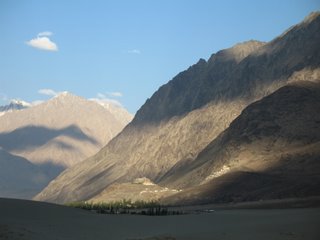
Disket Monastery From a Distance
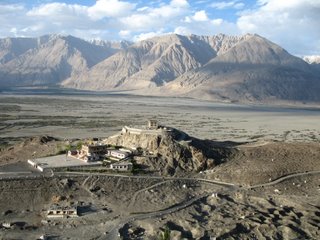
Part of Disket Monastery and the Nubra Valley
My words, at best, communicate a few, token details about what it's like to travel in the developing world. All five senses are assaulted or triggered in new ways in a place like India. At the time I wrote this, we were resting in late afternoon heat on sand dunes surrounded by mountains whose peaks have held snow for all human memory. Until I traveled there, I may never have known that a place of that particular beauty and majesty existed.
A friend in San Francisco, Shawn, sent a note that got me thinking about the worth of this kind of travel. Shawn is one of the sharpest people I know and lives a very full life back home so, when he poses a question, I take it to heart. In a recent e-mail he wondered to us and to himself:
In many ways, his words summarize the main part of my motivation for taking this journey. There are plenty of people in the Western world working their careers, having families and following the path of life that's been laid out for a long, long time. Again, I mean no disrespect to those on that path. I wouldn't be here is someone didn't choose to have me as part of their family. (Thanks, mom!) But, because I've been lucky enough to travel before, I am acutely aware that this is a vast and hugely varied planet. To not explore some of it and try to connect with those who live differently than I seems like a crippling limitation of what it means to live.
We are incredibly lucky to have been born in the US. The opportunities we can pursue might as well be magic to a majority of people in this world. By coming to a place like this and keeping an open heart, that magic becomes palpable to me in a way that simply is not possible at home.
No question, being out here is worth it.
Current Photos of North India
The previous post begs a question. If it's so 'grueling' out here in India (or anywhere in the developing world) is the adventure worth the discomfort? Are the deprivations you might suffer here, but can say goodbye to when you return home, akin to going on a fast from eating just so you enjoy food that much more because you're starving? Not at all. Oddly enough, pain is supposed to be one of the most difficult memories to conjure in our heads. Even a few days after a bus ride like the one I mention below you can laugh easily at the distress.
No, being out here you have a good chance of living a day worth telling a story about. At home, while working (unless you're in an exceptional situation), one day, week or month can bleed into another with no more to talk about than having seen an good movie or the final, climactic episode of American Idol. (No disrepect, those kinds of things are only so inspiring to me.) Since we've been on the road, at least once a week or so we have some kind of epic day. We see or experience something I never would have expected to see.
In Shimla, a city I mentioned in an earlier post, we were sitting under a little gazebo overlooking the main part of town. A cloudburst turned into a hailstorm. This grew into the most serious hailstorm I'd ever seen. What made it extra special was the fact that all the roofs in Shimla are made of corrugated metal and the buildings are very tightly packed. The sound of that hail grew to such a crescendo that I could not hear myself yell at the top of my lungs. It actually scared the heck out of me but, as soon as it stopped, everyone under the gazebo laughed and cheered and high-fived because they knew they just saw and heard something rare and powerful.
In Rishikesh we had to trek across a bridge four times a day going to and from yoga. Every time we crossed, we had to contend with religious pilgrims, holy men, scooters, cows and aggressive monkeys who'd try to steal any bag that looked like it might have food in it. This, while traversing an eighty-year old cable suspension "foot bridge" a hundred feet above the River Ganges. That commute bore little resemblance to my daily walk from the parking garage to my office in SF.
Wallace Stegner, a writer who emigrated from the pastoral East of the US to the wide-open and vast West, said that a key difference between the two regions was the scale. A person raised in the East had no vocabulary or relative comparisons for the spaces and mountains, colors and textures of the West. To understand its majesty he once said, "You have to get over the color green. You have to quit associating beauty with gardens or lawns; you have to get used to an inhuman scale; you have to understand geological time."
In many ways, for a person raised in a small Mid-western farm town then anchored in the beautiful but admittedly provincial boutique city that is San Francisco, inching my way through the Hindu heartlands or the Buddhist valleys of the Himalayas presents a similar disjunction in my ability to frame my experiences.
When you walk a longer distance, as Tami and I did a few days ago between the small villages of Hunder and Disket in the Nubra Valley, you know how miles feel. You can walk for hours and you don't pass a mountain by, you just change your perspective on it. We did the outbound trip in a bus, but only when we walked did I realize that you could actually see each town's monastery from the other's. On the bus, things happen and scenery passes too quickly to make such connections. This is part of what I think Stegner meant by scale differences. My experience has little to compare to the vast silence of a huge, still Himalayan valley. A thousand years ago and more, kingdoms , with their own complete histories, rooted themselves in these valleys. The remains and people are still here for anyone curious enough to see.
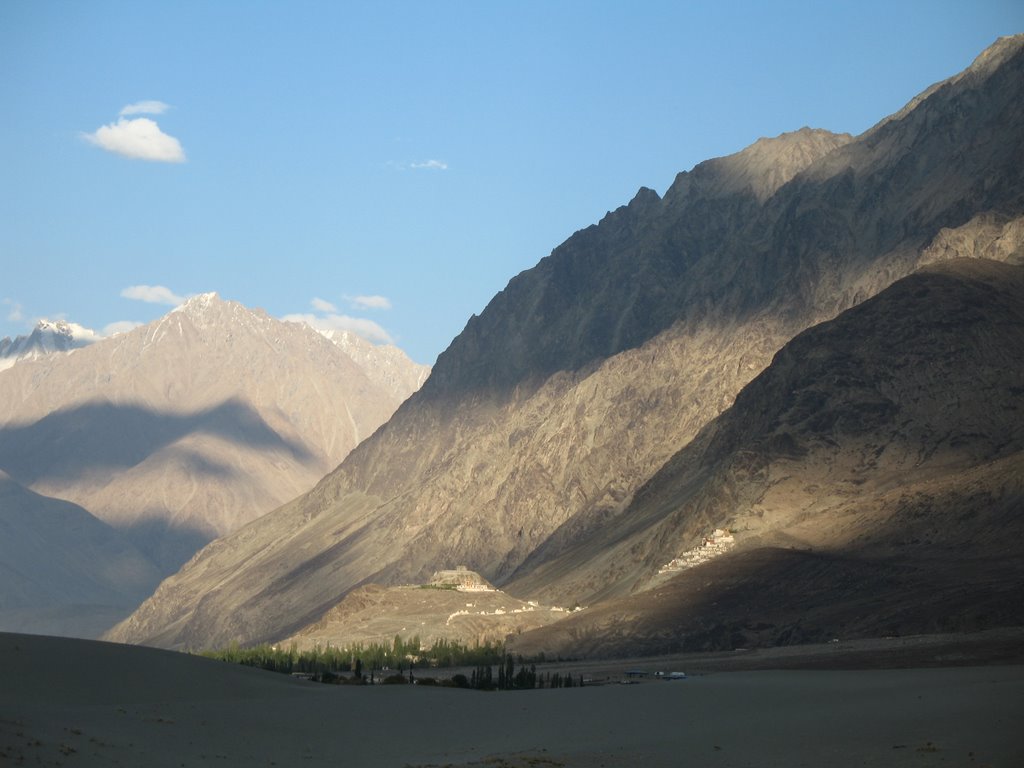
Disket Monastery From a Distance
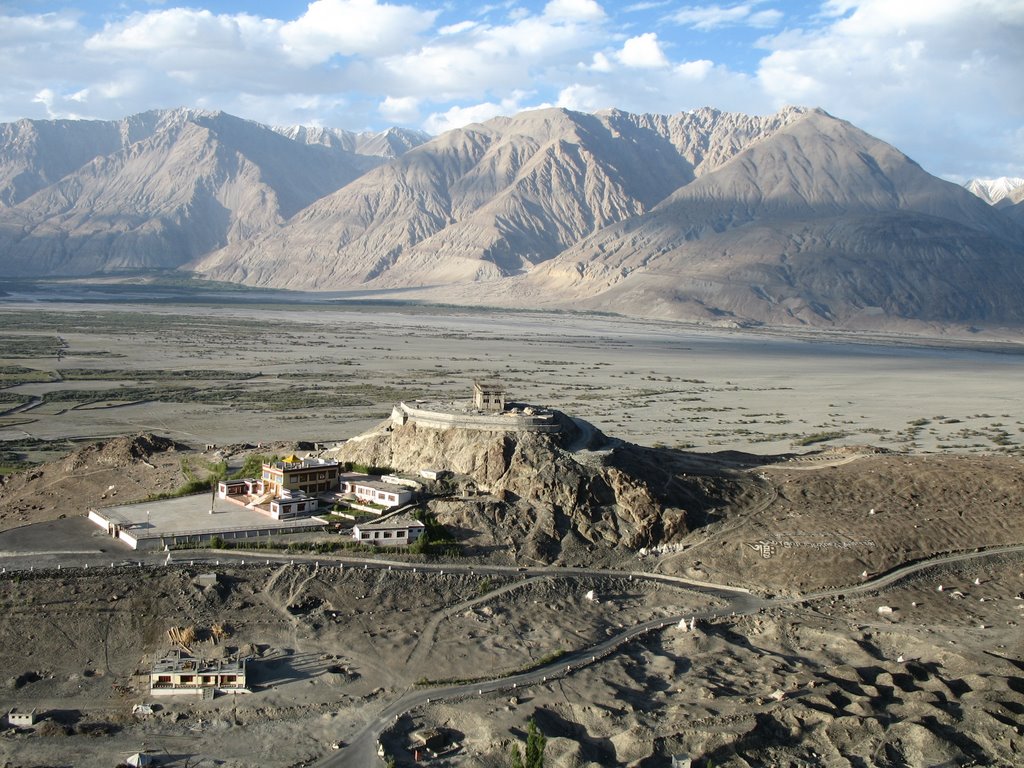
Part of Disket Monastery and the Nubra Valley
My words, at best, communicate a few, token details about what it's like to travel in the developing world. All five senses are assaulted or triggered in new ways in a place like India. At the time I wrote this, we were resting in late afternoon heat on sand dunes surrounded by mountains whose peaks have held snow for all human memory. Until I traveled there, I may never have known that a place of that particular beauty and majesty existed.
A friend in San Francisco, Shawn, sent a note that got me thinking about the worth of this kind of travel. Shawn is one of the sharpest people I know and lives a very full life back home so, when he poses a question, I take it to heart. In a recent e-mail he wondered to us and to himself:
"Yes, I really do think about you every day...about what you’re doing, what it means to you, to the people you meet, to us spectators. I imagine it’s something how Burn Night [edit. at BurningMan] used to be, with everybody wondering What Does It All Mean (if anything). What I do know is this: I can’t end my life NOT having had an adventure like that. This damn western cocoon is a little too comfortable."
In many ways, his words summarize the main part of my motivation for taking this journey. There are plenty of people in the Western world working their careers, having families and following the path of life that's been laid out for a long, long time. Again, I mean no disrespect to those on that path. I wouldn't be here is someone didn't choose to have me as part of their family. (Thanks, mom!) But, because I've been lucky enough to travel before, I am acutely aware that this is a vast and hugely varied planet. To not explore some of it and try to connect with those who live differently than I seems like a crippling limitation of what it means to live.
We are incredibly lucky to have been born in the US. The opportunities we can pursue might as well be magic to a majority of people in this world. By coming to a place like this and keeping an open heart, that magic becomes palpable to me in a way that simply is not possible at home.
No question, being out here is worth it.
Subscribe to:
Posts (Atom)
